

Artificial Disc Replacement Statistics (2026): Success Rates vs Fusion
Artificial disc replacement preserves motion instead of eliminating it, and for the right candidate the results are strong: lumbar satisfaction of 75 to 93 percent and a 10-year cervical success rate of 81 percent, versus 66 percent for fusion. The key word is candidate, since disc replacement suits specific conditions and careful selection drives the outcome.
- Lumbar disc replacement studies report patient satisfaction of roughly 75.5 to 93.3 percent.
- A 10-year cervical trial found an overall success rate of 81 percent for disc replacement versus 66 percent for fusion.
- The overall lumbar disc replacement reoperation rate was 12.1 percent, with most studies under 10 percent.
- Adjacent-level secondary surgery was lower for cervical disc replacement (10 percent) than fusion (16 percent) at 10 years.
- Lumbar meta-analyses have not consistently shown clear superiority of disc replacement over fusion, with similar complication and reoperation rates.
- Symptomatic adjacent-segment disease after lumbar disc replacement runs about 5 to 18 percent over 4 to 14 years.
- Candidacy is specific, so an experienced surgeon's evaluation is central to choosing disc replacement or fusion.
What's in This Guide
1What Disc Replacement Is and Why Motion Matters
Artificial disc replacement (ADR), also called total disc replacement or disc arthroplasty, removes a damaged disc and inserts a mechanical implant that preserves movement at that segment. This is the opposite philosophy to fusion, which eliminates motion to stabilize the spine.
The motivation for preserving motion is to protect the discs above and below from the extra stress that fusion can transfer to them, a problem known as adjacent-segment disease. Whether disc replacement delivers on that promise is one of the central questions the data addresses, and the answer differs somewhat between the cervical and lumbar spine.
Our Phoenix practice, led by board-certified neurosurgeon and spine surgeon Dr. David L. Greenwald, MD, FACS, offers both motion-preservation and fusion options and matches the approach to each patient's anatomy and goals.
Explore disc replacement in PhoenixSource: Lumbar TDR systematic review, PMC
2Success and Satisfaction Rates
Disc replacement has strong clinical results in well-selected patients, with high satisfaction and durable pain relief across both regions of the spine.
The strongest disc replacement evidence comes from the cervical spine, where multiple randomized trials have followed patients for a decade or more. A frequently cited 10-year study found cervical disc replacement reached 81 percent overall success versus 66 percent for fusion. Lumbar results are also good on satisfaction, though as the next section shows, the comparison with fusion is more nuanced.
Learn about cervical disc replacementSource: Lumbar TDR systematic review, PMC | Cervical disc replacement long-term outcomes, PMC 2026
3Disc Replacement vs Fusion
The comparison between disc replacement and fusion is one of the most studied questions in spine surgery, and the honest answer is that it depends on the region and the patient.
Cervical Disc Replacement vs Fusion: 10-Year Outcomes
Cervical disc replacement showed higher success and fewer adjacent-level surgeries at 10 years. Source: 10-year prospective RCT.
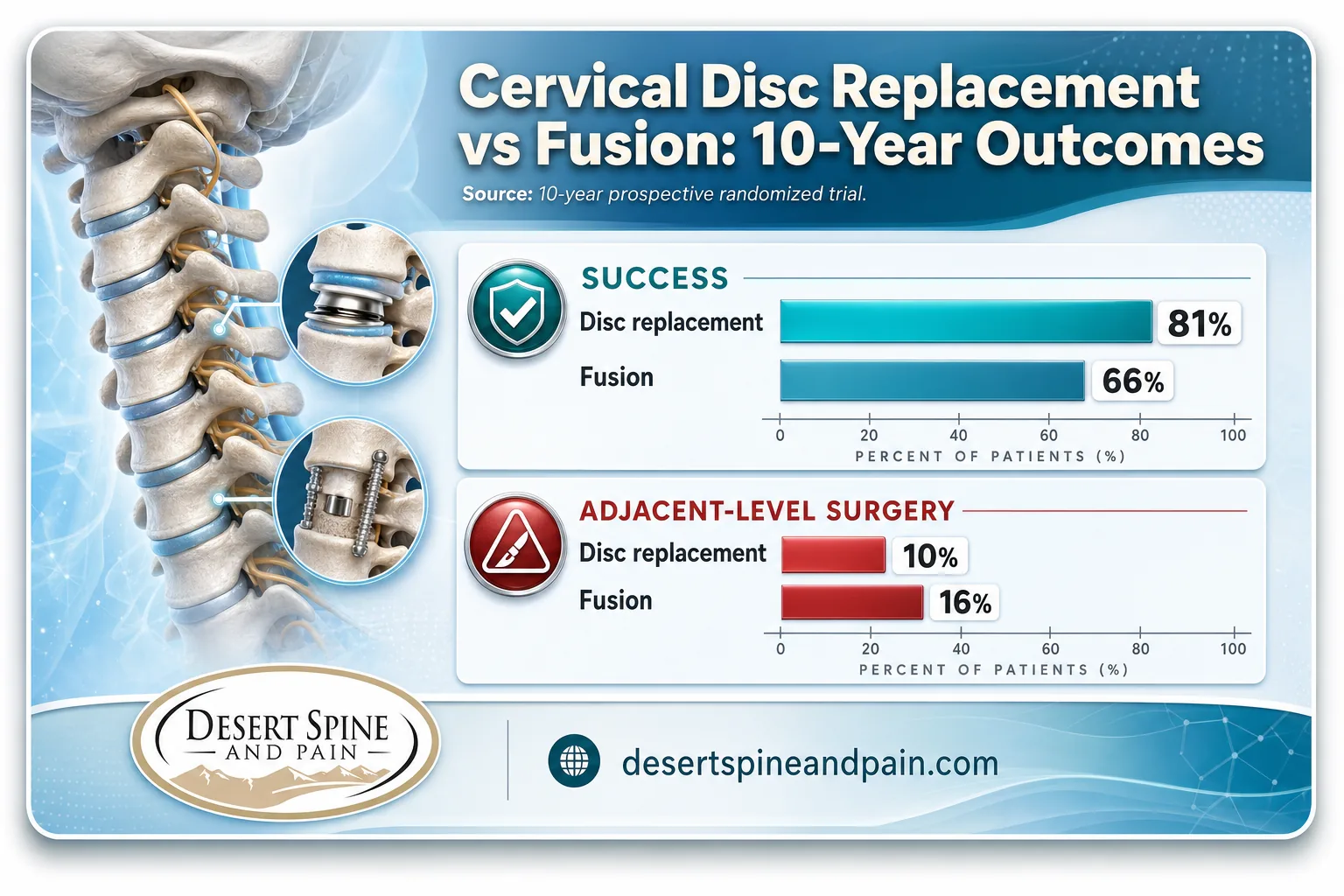
The picture is genuinely mixed. In the cervical spine, long-term trials tend to favor disc replacement for suitable patients, with higher success and fewer adjacent-level surgeries. In the lumbar spine, evidence is more balanced: some meta-analyses found no significant difference from fusion, while a more recent updated analysis found lower reoperation rates favoring disc replacement. This is exactly why the choice should be individualized rather than driven by a single headline.
The evidence does not support a blanket claim. Cervical disc replacement has strong long-term data for suitable patients, but lumbar meta-analyses have often found similar outcomes to fusion, not clear superiority. Marketing sometimes overstates the case. The truth is that disc replacement is an excellent option for the right candidate and the wrong choice for others. Matching the procedure to the patient, not to a trend, is what produces good statistics.
Source: TDR vs fusion meta-analysis, PMC | Updated TDR vs fusion meta-analysis, PMC
4Adjacent-Segment Disease and Reoperation
The central promise of disc replacement is that preserving motion protects neighboring discs. The reoperation and adjacent-segment data show real, if partial, benefit.
Most lumbar disc replacement studies report reoperation rates under 10 percent, with the pooled figure at 12.1 percent, which is comparable to or slightly better than fusion in several analyses. In the cervical spine, the reduction in adjacent-level surgery (10 versus 16 percent) is one of the clearest demonstrations that motion preservation can lower downstream operations. The benefit is meaningful but not absolute, adjacent-segment disease still occurs.
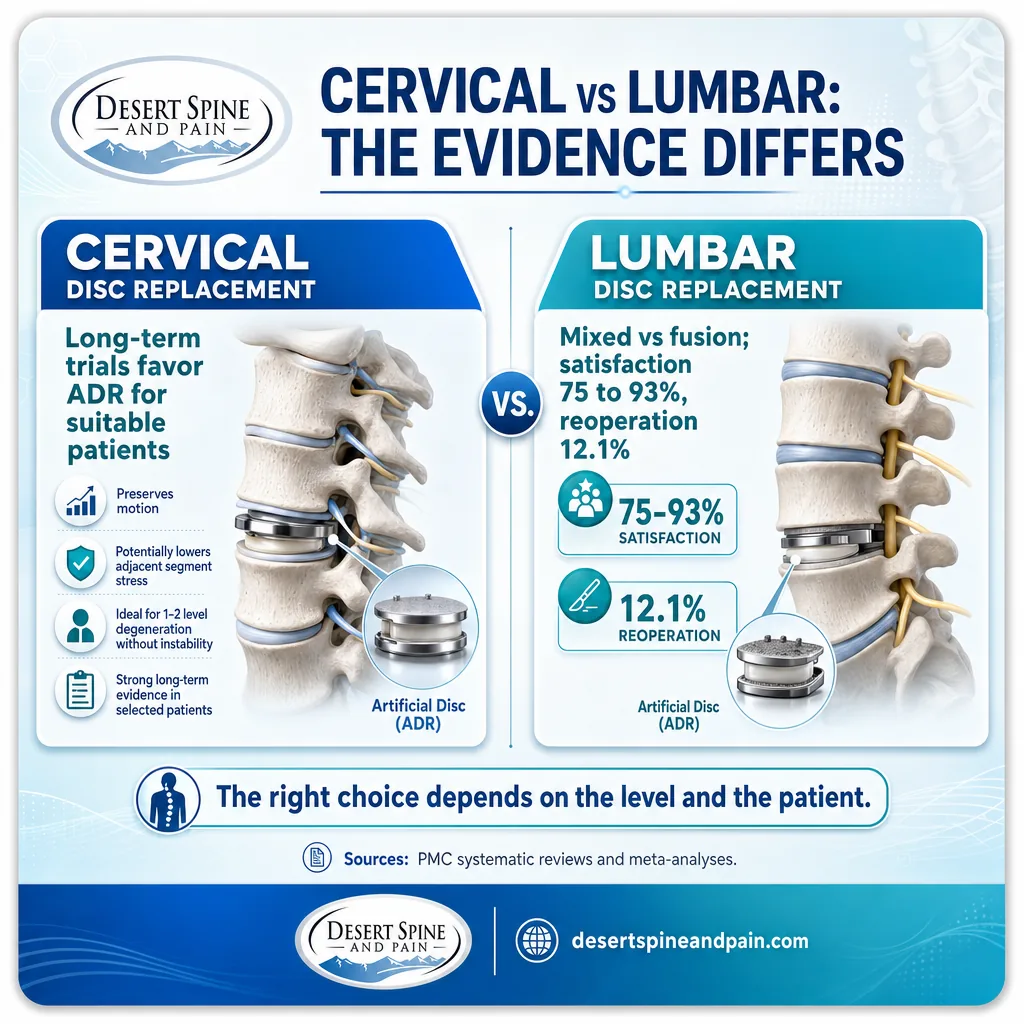
The cervical data (10 versus 16 percent adjacent-level surgery) shows disc replacement can meaningfully reduce downstream operations, while the mixed lumbar data shows it is not universally superior to fusion. Read together, the statistics support a measured conclusion: disc replacement is a strong, motion-preserving option for the right candidate, not a guaranteed upgrade for everyone. The value lies in accurate candidate selection, which is a clinical judgment, not a marketing claim. Interpretation original to Desert Spine and Pain.
Source: Lumbar TDR systematic review, PMC
5Who Qualifies
Perhaps the most important disc replacement statistic is not a success rate at all, but candidacy: whether a given patient is suited to the procedure in the first place.
Because candidacy is specific, the surgeon's evaluation is where a good disc replacement outcome begins. Selecting an appropriate candidate is what moves a patient toward the strong success rates seen in trials, and recognizing when fusion is the better option is equally important. This is a decision that rewards experience and honest counsel.
Desert Spine and Pain works with out-of-network patients of every kind and partners closely with personal injury attorneys, offering 24/7 concierge response and documentation coordination for injured clients evaluating their spine surgery options.
Compare fusion optionsSource: Cervical disc replacement long-term outcomes, PMC 2026
Summary Table: ADR Statistics 2026
| Statistic | Figure | Source | Year |
|---|---|---|---|
| Lumbar TDR patient satisfaction | 75.5 to 93.3% | Lumbar TDR systematic review | 2018 |
| Cervical ADR 10-year success | 81% | 10-year cervical RCT | 2019 |
| Cervical fusion 10-year success | 66% | 10-year cervical RCT | 2019 |
| Lumbar TDR reoperation rate (pooled) | 12.1% | Lumbar TDR systematic review | 2018 |
| Lumbar TDR complication range | 0 to 34.4% | Lumbar TDR systematic review | 2018 |
| Cervical ADR adjacent-level surgery | 10% | 10-year cervical RCT | 2019 |
| Cervical fusion adjacent-level surgery | 16% | 10-year cervical RCT | 2019 |
| Symptomatic adjacent-segment disease (4-14 yr) | 5 to 18% | Spine outcomes literature | 2026 |
| Lumbar TDR vs fusion (5-yr outcomes) | No significant difference | TDR vs fusion meta-analysis | 2010 |
| Lumbar TDR reoperation (updated meta-analysis) | Favors TDR | Updated TDR meta-analysis | 2019 |
| Cervical TDR vs ACDF revision (2-yr cohort) | 2.2% vs 1.2% | Retrospective cohort, PMC | 2023 |
| FDA IDE + real-world cohort analyzed | 303,103 patients | FDA-IDE real-world study | 2026 |
Frequently Asked Questions
What is the success rate of artificial disc replacement?
Is artificial disc replacement better than fusion?
What is the reoperation rate for artificial disc replacement?
Does artificial disc replacement reduce adjacent-segment disease?
Who is a candidate for artificial disc replacement?
Methodology & Sources
How we compiled these statistics
Every figure traces to a Tier 1 primary source: randomized controlled trials, systematic reviews, meta-analyses, and large database studies. Success, satisfaction, and reoperation ranges reflect differences in device, spinal level, follow-up length, and outcome definitions. Where the evidence is mixed, such as lumbar disc replacement versus fusion, we present that honestly. All statistics describe populations, not any individual patient.
Primary sources referenced:
- Mid- to long-term results of total disc replacement for lumbar degenerative disc disease: systematic review, PMC
- Meta-analyses of artificial total disc replacement versus fusion for lumbar degenerative disc disease (randomized controlled trials), PMC
- 10-year prospective randomized study of cervical disc replacement versus ACDF (232 patients)
- Long-term outcomes of cervical disc replacement and ACDF: FDA IDE trials with real-world comparison, PMC, 2026
- Retrospective comparative study of cervical total disc replacement versus ACDF, PMC
- 2025 review of spinal surgery outcomes (success-rate definitions)
This article is educational and is not individual medical advice. For guidance specific to your spine condition, consult a qualified spine surgeon. No outcome can be guaranteed.
Journalists and researchers may cite these statistics with attribution to Desert Spine and Pain and a link to this page. Please attribute the underlying figures to their original Tier 1 sources as listed above. For expert commentary on disc replacement data from a board-certified neurosurgeon and spine surgeon, contact Desert Spine and Pain at (602) 566-9500.