
ACDF Surgery Statistics (2026): Fusion Rates, Success by Level, and Outcomes
Anterior cervical discectomy and fusion (ACDF) is one of the most reliable spine operations for neck and arm pain, with single-level fusion rates of roughly 94 to 97 percent. The single biggest factor in the outcome is how many levels are treated: fusion becomes markedly harder with each added level, which is why surgical planning and technique matter so much.
- Single-level ACDF fuses in about 94 to 97 percent of cases, with excellent relief of arm pain and radiculopathy.
- Fusion becomes harder with more levels: a randomized trial found three-level ACDF fused only 17 percent at 12 months alone, rising to 61 percent with added posterior fixation.
- In multilevel series, pseudarthrosis reached 56 percent of four-level patients versus 42 percent of three-level, with about 11 percent needing secondary surgery.
- Multilevel constructs take longer to fuse: about 4.1 months for three-level and 5.25 months for four-level.
- Elderly patients (70+) still improved across all outcome measures after multilevel ACDF, with modestly higher short-term complications.
- ACDF has historically been the most common cervical procedure, at about 61.6 percent of cervical cases, though disc replacement is growing.
- Because level count drives fusion difficulty, surgeon planning and technique are central to a good result.
What's in This Guide
1What ACDF Is and How Common It Is
ACDF removes a damaged cervical disc through a small incision at the front of the neck, then fuses the adjacent vertebrae to stabilize the segment. It is the workhorse operation for cervical radiculopathy and myelopathy caused by disc disease.
Although ACDF remains the most common cervical procedure, its share is gradually declining as motion-preserving disc replacement grows for suitable candidates. Both options have a place, and choosing between them is part of what a careful evaluation determines.
Our Phoenix practice, led by board-certified neurosurgeon and spine surgeon Dr. David L. Greenwald, MD, FACS, performs ACDF and evaluates every cervical patient across the full range of options, including motion preservation.
Explore ACDF options in PhoenixSource: Multilevel ACDF outcomes, Journal of Spine Surgery | World Neurosurgery (national cervical spine trends), 2025
2Fusion and Success Rates by Level
The defining ACDF statistic is the fusion rate, whether the bone graft successfully unites the vertebrae. For single-level surgery, it is excellent, and clinical success closely follows.
Single-level ACDF sets a high bar: fusion rates around 94 to 97 percent, even in studies without plating, and strong, durable relief of arm symptoms. This is why ACDF has been a first-line surgical option for single-level cervical radiculopathy for decades. The reliability of the single-level procedure is exactly what makes the multilevel picture worth understanding.
Learn about cervical fusionSource: Multilevel ACDF outcomes, Journal of Spine Surgery | Zero-profile ACDF outcomes, PMC
3The Multilevel Challenge
As ACDF extends to more levels, fusion becomes progressively harder because more bone surfaces must heal and more soft tissue must be moved. The best evidence comes from a recent randomized controlled trial.
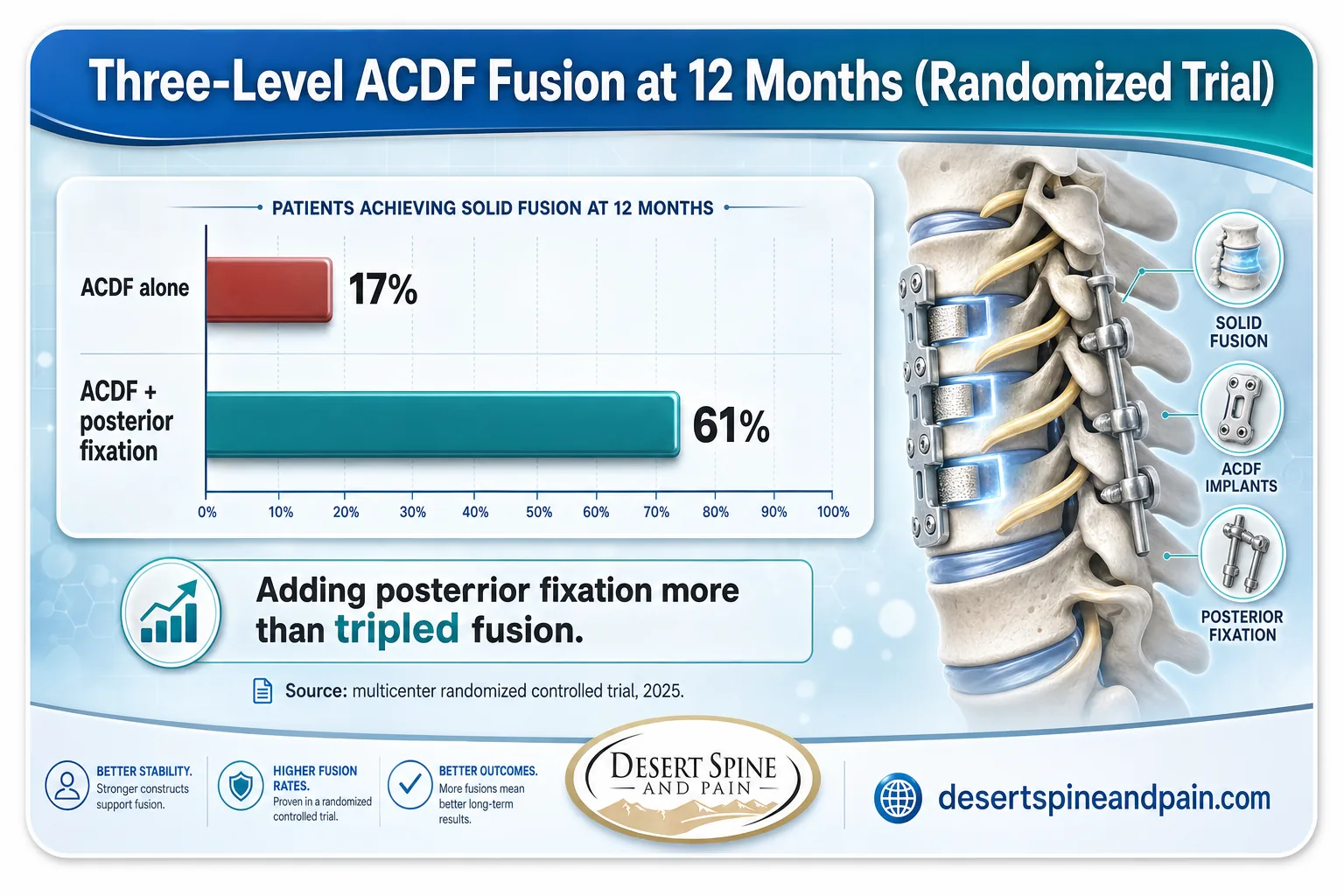
The 2025 randomized trial was the first of its kind for three-level cervical disc disease, and its finding was striking: long-segment ACDF alone had low fusion and high revision rates, but adding supplemental posterior fixation improved fusion without increasing surgical complications. This is a clear example of how a surgeon's technical strategy, not just the diagnosis, determines the outcome.
The data strongly disagrees. Single-level ACDF fuses in 94 to 97 percent of cases, but three-level ACDF alone fused only 17 percent at 12 months in a randomized trial. The number of levels dramatically changes fusion difficulty, revision risk, and the technique required. This is exactly why multilevel cervical disease demands an experienced surgeon who can choose and execute the right construct, such as adding posterior fixation when indicated.
Source: Three-level ACDF randomized controlled trial, PubMed 2025
4Revision and Pseudarthrosis
Pseudarthrosis, or failed fusion, is the main driver of revision surgery after ACDF, and its rate climbs sharply with the number of levels.
The pattern is unmistakable: each added level raises the odds of non-union, and the most caudal (lowest) level is the most likely to fail. Importantly, not every pseudarthrosis is symptomatic, only about 11 percent of patients in this series needed a secondary operation, but the risk rises steeply enough that multilevel planning must account for it.
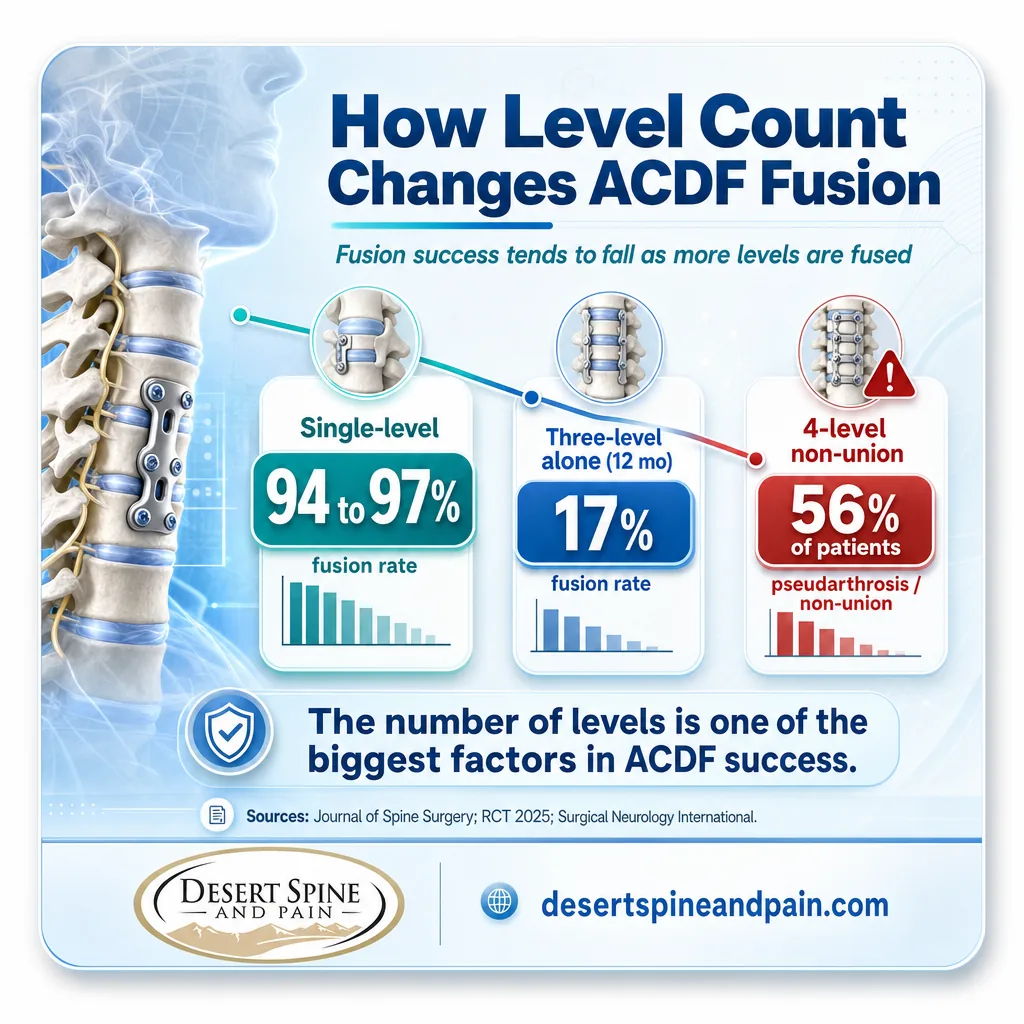
Reading the fusion data together, single-level fusion at 94 to 97 percent, three-level ACDF alone at 17 percent at one year, and four-level pseudarthrosis at 56 percent of patients, shows that the number of levels is one of the single largest determinants of ACDF success. This is why an experienced surgeon's decision about approach, fixation, and biologics for multilevel disease can move the outcome dramatically. The construct is a choice, and the choice shapes the statistics. Interpretation original to Desert Spine and Pain.
Source: ACDF complication rates review, Surgical Neurology International
5Outcomes in Older Patients
With an aging population, a common question is whether ACDF is worthwhile in older patients. The evidence supports carefully selected surgery even in the elderly.
The message for older patients is encouraging but nuanced: ACDF can deliver meaningful improvement even after age 70, though short-term complication rates are higher and the magnitude of improvement somewhat lower. This is precisely the kind of case where surgical experience and careful medical optimization make the difference between a good and a poor outcome.
Desert Spine and Pain works with out-of-network patients of every kind and partners closely with personal injury attorneys, offering 24/7 concierge response and documentation coordination for injured clients, including those with cervical injuries.
Compare motion-preservation optionsSource: Multilevel ACDF in elderly patients, PMC
Summary Table: ACDF Statistics 2026
| Statistic | Figure | Source | Year |
|---|---|---|---|
| ACDF share of cervical cases | 61.6% | World Neurosurgery | 2025 |
| Single-level ACDF fusion rate | 94 to 97% | Journal of Spine Surgery | 2018 |
| Three-level ACDF fusion at 12 mo (alone) | 17% | Multicenter RCT | 2025 |
| Three-level ACDF fusion at 12 mo (+ posterior fixation) | 61% | Multicenter RCT | 2025 |
| Pseudarthrosis (levels), 3-4 level ACDF | 14% | SNI review (Wewel) | 2019 |
| Patients with non-union, 3-level | 42% | SNI review | 2019 |
| Patients with non-union, 4-level | 56% | SNI review | 2019 |
| Secondary surgery for symptomatic non-union | 11.1% | SNI review | 2019 |
| Time to fusion, 3-level | 4.09 months | SNI review | 2019 |
| Time to fusion, 4-level | 5.25 months | SNI review | 2019 |
| Zero-profile cage series: infections/readmissions | 0 of 190 | PMC study | 2021 |
| Elderly (70+) improvement after ACDF | All measures | 2024 ACDF myelopathy study | 2024 |
| Short-term complications, elderly vs younger | 61.1% vs 35.6% | PMC elderly ACDF study | 2022 |
Frequently Asked Questions
What is the success rate of ACDF surgery?
How does the number of levels affect ACDF success?
What is the pseudarthrosis rate for multilevel ACDF?
Is ACDF safe for elderly patients?
How long does ACDF take to fuse?
Methodology & Sources
How we compiled these statistics
Every figure traces to a Tier 1 primary source: randomized controlled trials, cohort studies, and peer-reviewed reviews. Fusion and success rates vary by number of levels, technique, graft, and patient factors, so we present figures by level count and attribute each. Some multilevel figures come from single-center series and are noted as such. All statistics describe populations, not any individual patient.
Primary sources referenced:
- Three-level ACDF with or without investigational posterior stabilization, multicenter randomized controlled trial, 2025
- Outcomes and revision rates following multilevel ACDF, Journal of Spine Surgery
- A review of complication rates for ACDF (multilevel pseudarthrosis data), Surgical Neurology International
- Retrospective evaluation of single- and multilevel ACDF with zero-profile stand-alone cage, PMC
- Surgical outcome of multilevel ACDF in myelopathic elderly and younger patients, PMC
- World Neurosurgery, national cervical spine trends (PearlDiver), 2025
This article is educational and is not individual medical advice. For guidance specific to your cervical spine condition, consult a qualified spine surgeon. No outcome can be guaranteed.
Journalists and researchers may cite these statistics with attribution to Desert Spine and Pain and a link to this page. Please attribute the underlying figures to their original Tier 1 sources as listed above. For expert commentary on ACDF surgery data from a board-certified neurosurgeon and spine surgeon, contact Desert Spine and Pain at (602) 566-9500.