

Why Spinal Fluid Leaks Can Happen After Back Surgery
In plain terms: A spinal fluid leak after back surgery almost always comes from a small tear in the dura, the thin membrane that seals cerebrospinal fluid around the spinal cord and nerves. That tear, called an incidental durotomy, can happen because the dura is thin, scarred, or stuck to nearby tissue, and the pressurized fluid then seeps through. Most leaks are identified and managed successfully, and knowing the warning signs helps you get care quickly.
If your surgeon mentioned a spinal fluid leak, or you are reading about it before an operation, it is natural to feel uneasy. The short answer is this: cerebrospinal fluid leaks after back surgery because the thin membrane that holds that fluid, the dura, develops a small opening during the procedure. It is one of the more common complications in spine surgery, it is usually treatable, and it does not automatically mean something went wrong. This guide explains why these leaks happen, who is most at risk, the symptoms to watch for, how they are diagnosed and treated, and how the right surgical approach keeps the risk low.
- A spinal fluid leak comes from a tear in the dura, the membrane that holds cerebrospinal fluid (CSF) around the spinal cord and nerves. A surgical tear is called an incidental durotomy.
- The tear can happen because the dura is thinned by age, scarred from a prior operation, stuck to surrounding tissue, or nicked while bone or disc is removed, and a small bone spur can also abrade it.
- Reported leak rates run from about 1% to 17% depending on the procedure, and revision surgery carries roughly twice the risk of a first operation.
- The classic symptom is a positional headache, worse upright and better lying flat, but not everyone with a leak has a headache.
- Most leaks are managed with repair during surgery, then conservative care such as bed rest, fluids, and caffeine, with a blood patch or lumbar drain if needed.
What's in This Guide
- What a Spinal Fluid Leak After Back Surgery Actually Is
- Why a Leak Happens: The Dural Tear and Its Causes
- How Common Is It, and Who Is Most at Risk?
- Signs and Symptoms of a Spinal Fluid Leak
- What Can Happen If a Leak Is Not Treated
- How Spinal Fluid Leaks Are Diagnosed and Treated
- How the Right Surgical Approach Lowers the Risk
- How to Get Started
- Common Questions
- Sources
What a Spinal Fluid Leak After Back Surgery Actually Is
Your brain and spinal cord float in a cushion of clear cerebrospinal fluid, or CSF. In the spine, that fluid is held inside a thin, tough, watertight sleeve called the dura mater. The dura wraps the spinal cord and the nerve roots and keeps the fluid sealed and under gentle pressure, the way a balloon holds air.
A spinal fluid leak after surgery means that sleeve has a small opening in it. When the opening is created during an operation, surgeons call it an incidental durotomy, which means an unplanned tear in the dura. Because the CSF inside sits at a slightly higher pressure than the tissue around it, fluid escapes through the tear instead of staying sealed, and that is the leak.
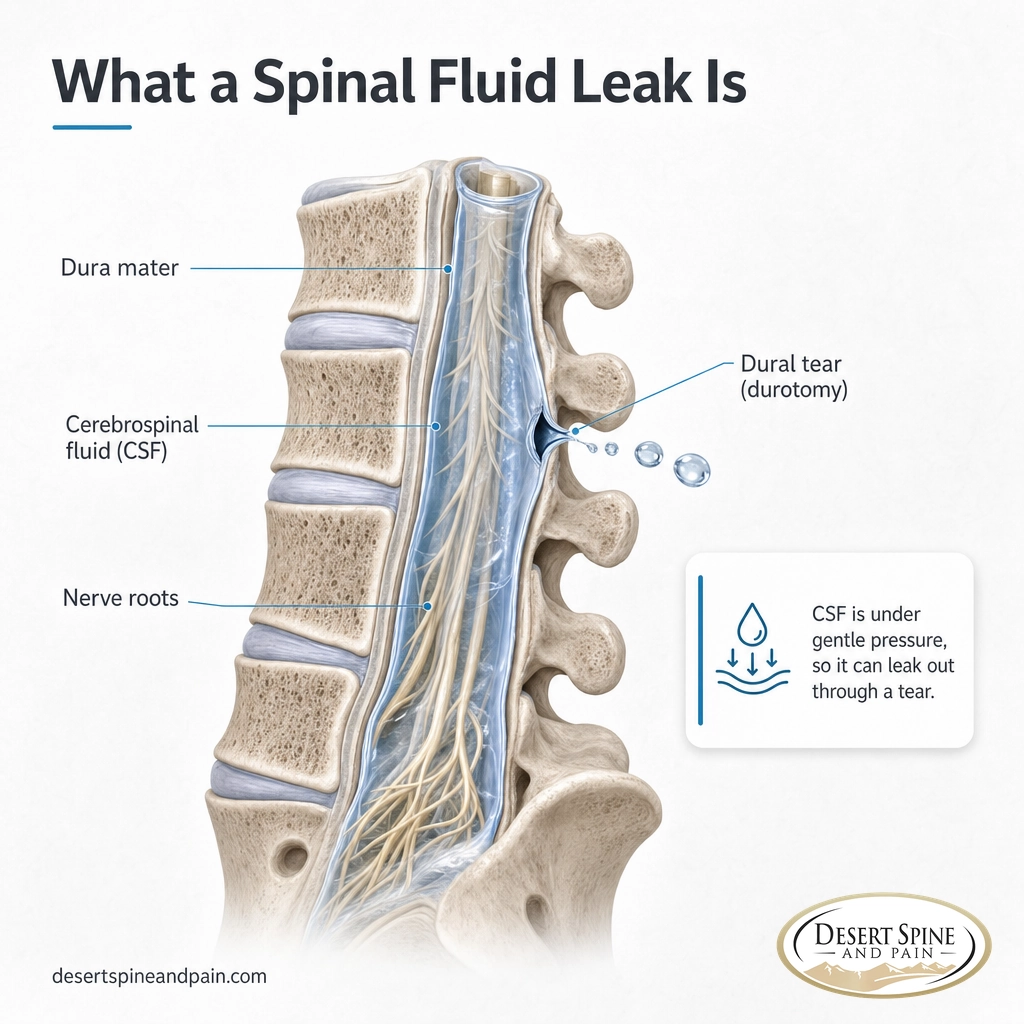
That is the core idea to carry through the rest of this guide. The spine itself is not leaking. A thin membrane around the nerves has a small hole, and the clear fluid it normally contains is finding a way out. Whether that causes symptoms, and what is done about it, depends on how and where the tear happened and whether it was sealed.
Source: AO Foundation (AO Spine): Incidental Lumbar Durotomy | Cleveland Clinic: Epidural Blood Patch
Why a Leak Happens: The Dural Tear and Its Causes
A dural tear is rarely about one single slip. More often it reflects the condition of the dura itself and how much work the operation requires near it. Several factors make a tear more likely, and they often combine.
- The dura is thin or fragile. With age and wear, the membrane can thin out, which makes it easier to nick while nearby bone or disc material is being removed.
- Scar tissue from a prior surgery. After a first operation, scar tissue can bind the dura to the structures around it. Separating it during a second operation is delicate work, which is why revision surgery carries a higher risk.
- The dura is stuck to surrounding tissue. Conditions like severe spinal stenosis can press the dura tightly against bone and ligament, so freeing the nerves can tear the membrane.
- A bone spur or sharp edge. A small spike of bone left against the dura can abrade or puncture it, sometimes causing a tear that is not obvious at the moment it forms.
- Extensive or complex work. The more levels of the spine involved, and the more tissue that must be cleared, the more surface area is at risk.

There is one more important point. Some tears are small and are not noticed during the operation, so the leak only becomes apparent afterward. That is not a sign of carelessness. It reflects how fine the dura is and how hidden a tiny opening can be. The practical lesson is that recognizing the signs after surgery matters just as much as careful technique during it.
Source: AO Foundation (AO Spine): Incidental Lumbar Durotomy | BMC Surgery (2022): CSF leakage following lumbar posterior surgery
How Common Is It, and Who Is Most at Risk?
A spinal fluid leak is uncommon, but it is not rare, and it is a well-documented risk that spine surgeons watch for closely. How often it happens depends heavily on the type of surgery and where in the spine it is performed.
In one large review of lower-back operations, the rate sat near the lower end of that range, a reminder that for a typical first-time procedure a leak is the exception, not the rule.
The risk is not the same for everyone. It climbs with the complexity of the surgery and with the state of the tissue the surgeon has to work through. The same lower-back study identified four factors that raised the risk of a leak:
- The underlying diagnosis being treated (for example, conditions that press the dura tightly against bone)
- Having had preoperative epidural steroid injections
- The number of spinal levels operated on
- Revision surgery, meaning a repeat operation at a previously treated area
Revision surgery stands out, because scar tissue from the first operation makes the dura harder to free safely.
The surgical approach matters too. Reported leak rates tend to rise as a procedure becomes more invasive or works in tighter, more scarred spaces, while gentler and more targeted approaches tend to sit at the lower end.
Reported dural tear / CSF leak rates by spine procedure (context-specific)
Rates vary widely by procedure, spinal level, and study. These figures are context-specific, not a single leak rate. Sources: AO Foundation (AO Spine), 2022; BMC Surgery, 2022.Myth: "A spinal fluid leak means the surgeon made a mistake." Usually not. An incidental durotomy is a recognized risk of spine surgery even in experienced hands, and it is more likely when the dura is thin, scarred from a prior operation, or stuck to surrounding tissue. What truly matters is that a tear is found and managed well. Skilled, careful technique lowers the odds, but no surgeon can promise a tear will never occur.
Source: AO Foundation (AO Spine): Incidental Lumbar Durotomy | BMC Surgery (2022)

Signs and Symptoms of a Spinal Fluid Leak
The most recognizable sign of a spinal fluid leak is a headache that changes with your position. It tends to be worse when you sit up or stand and to ease, sometimes within minutes, when you lie flat. This happens because losing fluid lowers the pressure that normally cushions the brain, and standing up makes that drop more noticeable.
A leak can bring other symptoms as well, and they do not always appear together:
- Nausea or vomiting
- Neck stiffness or pain
- Sensitivity to light
- Ringing in the ears, ear fullness, or muffled hearing
- Dizziness or a spinning sensation
- Clear, watery fluid draining from the incision
- A soft, growing swelling under the wound, which can be a collection of fluid called a pseudomeningocele

One point surprises many patients: you can have a leak without the classic headache. Some people have a leak confirmed on imaging yet never develop a positional headache, so the absence of one does not rule a leak out. That is why surgeons look at the whole picture, including wound drainage and swelling, rather than relying on a headache alone.
| Feature | Ordinary post-surgery recovery | Possible spinal fluid leak |
|---|---|---|
| Headache pattern | Mild and fairly steady, not strongly tied to position | Clearly worse sitting or standing, better lying flat |
| Wound | Expected soreness, dry or lightly dressed | Clear watery drainage or a soft, growing swelling |
| Other clues | Gradual improvement day by day | Nausea, neck stiffness, light sensitivity, ringing in the ears |
| What to do | Follow your recovery plan, keep follow-up visits | Contact your surgeon promptly for evaluation |
Seek urgent care for these red flags. A fever with neck stiffness and confusion, a sudden severe headache, or clear fluid steadily draining from the incision needs immediate evaluation, not watchful waiting. Fever and neck stiffness can point to infection or meningitis, which is the main reason an untreated leak must not be ignored.
Source: AO Foundation (AO Spine): Incidental Lumbar Durotomy
What Can Happen If a Leak Is Not Treated
Most spinal fluid leaks are identified and resolved without lasting problems. The reason surgeons take them seriously is that an opening in the dura is also a potential pathway for bacteria, and a leak that is left to persist can lead to complications.
Reported consequences of an unmanaged durotomy include a persistent pocket of fluid under the wound (a pseudomeningocele), wound healing problems, and, less commonly but more seriously, infection that can reach the lining of the nervous system and cause meningitis. These outcomes are uncommon, and they are exactly what prompt treatment is designed to prevent, which is why reporting symptoms early is so valuable.
Source: AO Foundation (AO Spine): Incidental Lumbar Durotomy | Cleveland Clinic: Epidural Blood Patch
How Spinal Fluid Leaks Are Diagnosed and Treated
When a tear is seen during surgery, the best moment to deal with it is right then. Surgeons aim for a watertight closure, often with fine sutures and a sealant such as a fibrin product, because a secure seal at the time of surgery is the strongest protection against a leak afterward.
When a leak shows up after surgery, or when a small tear was repaired but still seeps, treatment usually starts gently and escalates only if needed:
- Conservative care first. A period of flat bed rest, extra fluids, and caffeine gives a small tear a chance to seal while easing the positional headache. Many surgeons prescribe a focused window of rest after the operation for this reason.
- Epidural blood patch. If symptoms persist, a small amount of the patient's own blood is injected into the space near the leak, where it clots and helps seal the opening. It is a common next step and can be repeated if necessary.
- Lumbar drain. A thin temporary drain can lower the fluid pressure at the tear so the dura can heal, an approach often used for stubborn leaks.
- Repeat repair. A large or persistent leak may need a return to the operating room to close the dura directly. This is less common but important when simpler measures are not enough.
It is worth knowing that there is no single universally agreed recipe for managing these leaks, which is why the plan is tailored to the size and location of the tear, your symptoms, and how the dura looked during surgery. An experienced surgeon chooses the least aggressive step likely to work and moves up only if the leak does not settle.
Source: Cleveland Clinic: Epidural Blood Patch | AO Foundation (AO Spine): Incidental Lumbar Durotomy
How the Right Surgical Approach Lowers the Risk
You cannot change the shape of your own anatomy or erase scar tissue from a previous operation, but the choices made before and during surgery meaningfully affect the odds of a leak. Two things carry the most weight: the experience of the surgeon and how invasive the approach needs to be.
Gentler, more targeted techniques work in smaller spaces and disturb less tissue, which is one reason a least-invasive-first philosophy matters. Where it is appropriate, minimally invasive spine surgery uses small corridors to reach the problem, and avoiding a larger open dissection can reduce the surface area where the dura is at risk. The right approach is always the one that safely solves the problem, which sometimes means a larger operation, but the principle is to use the least invasive effective option.
Experience matters just as much, especially for the higher-risk situations covered above, such as revision operations and tightly scarred or stenotic spines. A surgeon who performs these procedures often, and who is trained to work safely around the dura and the nervous system, is better positioned both to prevent a tear and to repair one cleanly if it occurs. This is one reason a second opinion before spine surgery, particularly a repeat operation, is so valuable.
At Desert Spine and Pain in Phoenix, Arizona, care is led by Dr. David L. Greenwald, MD, FACS, a board-certified surgeon who is both a spine surgeon and a neurosurgeon, and who treats the spine and nervous system as a single connected system. Care starts with the least invasive effective option and moves toward surgery only when it is genuinely the best path.
Source: AO Foundation (AO Spine): Incidental Lumbar Durotomy
How to Get Started
If you are weighing back surgery, recovering from one, or worried about a possible leak, the most useful next step is a focused evaluation that connects your symptoms and imaging to a clear plan. It is also the right time to ask about the least invasive options for your situation and to get a second opinion before any operation, especially a revision.
Desert Spine and Pain draws patients from across the Greater Phoenix area and beyond for complex spine care, and the practice works closely with patients and, where relevant, their personal injury attorneys. If you are navigating a spine condition or considering surgery, a consultation is the place to get your questions answered.
Explore spine surgery at Desert Spine and Pain
Learn about laminectomy and decompression surgery
Book a consultation or second opinion
Common Questions About Spinal Fluid Leaks After Surgery
Why would spinal fluid leak after back surgery?
How common is a CSF leak after spine surgery?
What are the symptoms of a spinal fluid leak after surgery?
Does a spinal fluid leak mean the surgeon made a mistake?
How is a spinal fluid leak after back surgery treated?
When should I call my surgeon after spine surgery?
Sources
Sources and Methodology
This guide summarizes established clinical references and peer-reviewed data on cerebrospinal fluid (CSF) leaks and incidental durotomy after spine surgery. Incidence figures and risk factors are drawn from a specialty surgical education source and a peer-reviewed study of lumbar posterior surgery, and are presented as general reference, not individual predictions. It is educational information, not medical advice. Decisions about diagnosis and treatment should be made with a qualified spine specialist after an in-person evaluation.