

What Steroid Is Used for Trigger Point Injections?
The short answer: Many trigger point injections use no steroid at all. The usual injection is a local anesthetic such as lidocaine or procaine, sometimes plain saline, and some are done with no medicine (dry needling). When a corticosteroid is added, it is a standard injectable steroid like methylprednisolone, triamcinolone, or dexamethasone, though the added benefit for muscle knots is limited.
If you have been told you need a trigger point injection, it is natural to ask exactly what is going into the needle, and whether that includes a steroid. The honest answer surprises most people: a trigger point injection often contains no steroid at all. The core treatment is usually a small amount of local anesthetic, and in many cases the needle alone is what relieves the pain. A corticosteroid is an optional ingredient a physician may add in certain situations, not a standard part of the injection. This guide explains what actually goes into a trigger point injection, which steroids are used on the occasions one is added, how steroid compares to anesthetic and dry needling, and how to tell whether a steroid is right for your situation.
- A trigger point injection does not have to contain a steroid, and often does not. The standard injectate is a local anesthetic such as 1 percent lidocaine or procaine, or in some cases saline or no medicine at all.
- When a corticosteroid is used, it is one of the usual injectable steroids in musculoskeletal medicine: methylprednisolone (Depo-Medrol), triamcinolone (Kenalog), or dexamethasone.
- Evidence indicates the mechanical effect of the needle, not the drug, provides much of the relief, which is why dry needling and anesthetic-only injections both work.
- Corticosteroids injected into muscle carry a risk of tissue injury, so steroid is used selectively rather than by default for trigger points.
- The best choice depends on your diagnosis, the muscle involved, and the experience of the physician performing the injection.

What's in This Guide
- The Short Answer: Often No Steroid at All
- Which Steroid Is Used When One Is Added
- Steroid vs. Anesthetic vs. Saline vs. Dry Needling
- Why Many Trigger Point Injections Skip the Steroid
- Is a Steroid Trigger Point Injection Right for You?
- How a Trigger Point Injection Is Done
- Common Questions
- Related Injection Terms
- Sources
The Short Answer: Often No Steroid at All
A trigger point is a tight, tender knot in a taut band of muscle. The classic clinical description is a discrete, focal, hyperirritable spot in a band of skeletal muscle that is painful to press and can refer pain to other areas. A trigger point injection aims to calm that knot and break the pain cycle. The key thing to understand is that the medicine is not always what does the job.
The most common thing injected is a local anesthetic. A solution of 1 percent lidocaine or 1 percent procaine, without epinephrine, is the standard choice, and only a very small volume (about 0.2 mL) is placed once the needle is inside the trigger point. Some injections use saline instead, and some use no fluid at all. That last option, called dry needling, relies purely on repeated needle passes through the knot.
So where does steroid fit in? A corticosteroid is just one more substance a physician can choose to add, alongside options like local anesthetic, saline, and in some cases other agents. It is not the default and it is not required. For the majority of straightforward muscle trigger points, a steroid adds little and is left out.
Source: American Academy of Family Physicians: Trigger Point Management | Desert Spine and Pain trigger point injections overview
Which Steroid Is Used When One Is Added
When a physician does decide a corticosteroid belongs in the injection, the drug chosen is not unique to trigger points. It comes from the same family of injectable steroids used throughout joint and soft-tissue injections. The most common options are:
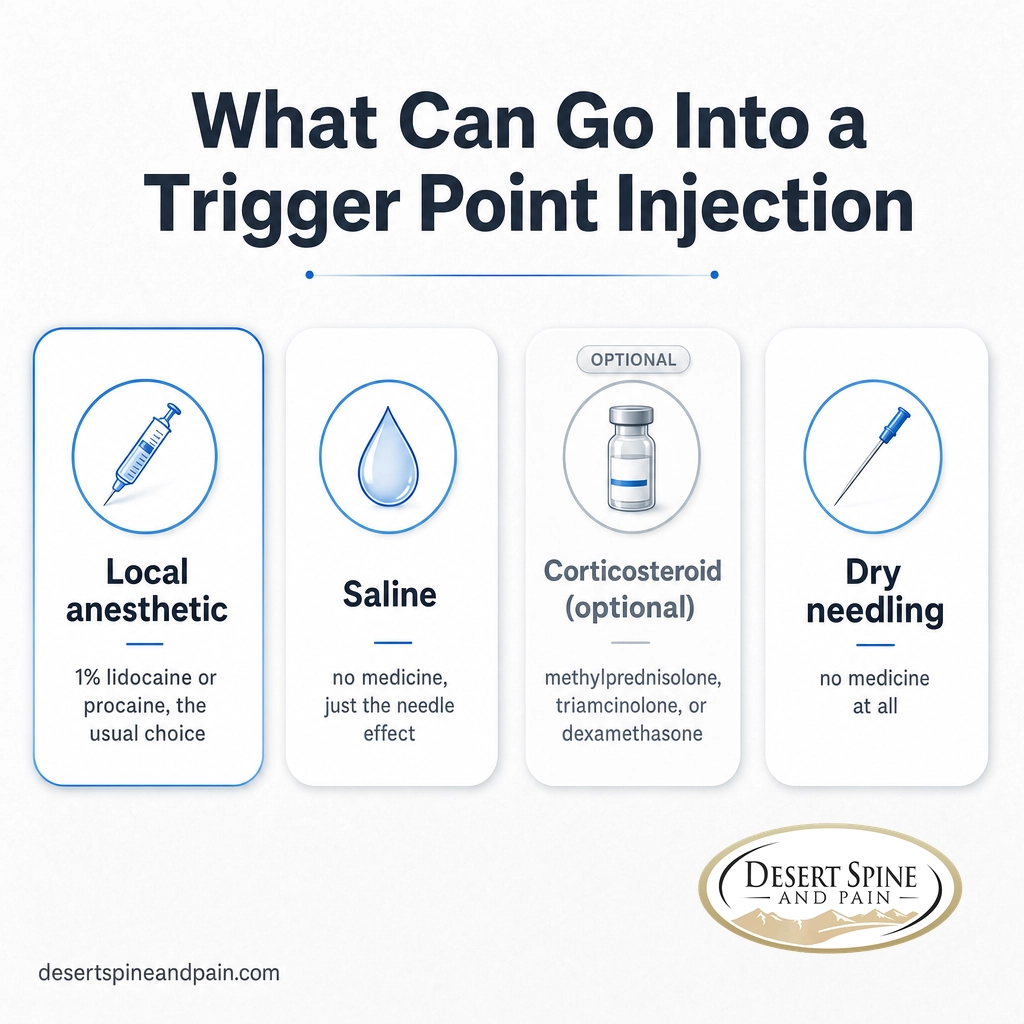
- Methylprednisolone (Depo-Medrol). A long-acting corticosteroid widely used for musculoskeletal injections. It is one of the most frequently chosen steroids when an anti-inflammatory effect is wanted.
- Triamcinolone (Kenalog). Another long-acting injectable corticosteroid common in joint and soft-tissue injections. It is potent, which is also why clinicians are careful about how much and how often it is used near muscle and skin.
- Dexamethasone. A corticosteroid that is less likely to leave a particle deposit at the injection site, sometimes preferred when a physician wants an anti-inflammatory effect with a lower risk of local tissue changes.
A corticosteroid reduces inflammation in and around the injected area. The logic for adding one to a trigger point injection is that some painful muscle problems involve an inflammatory component, or sit next to an inflamed structure, where a steroid may help. The amount used is small, and it is typically combined with the local anesthetic rather than injected on its own.
Importantly, which steroid is used, how much, and whether to use one at all are clinical decisions. They depend on your specific diagnosis, where the trigger point is, your other medical conditions, and how many steroid injections you may have already received. There is no single universal recipe, which is exactly why these injections should be performed by an experienced pain physician rather than treated as a one-size dose.
Source: American Academy of Family Physicians: Trigger Point Management | Desert Spine and Pain epidural steroid injections
Steroid vs. Anesthetic vs. Saline vs. Dry Needling
Because a trigger point injection can be done several ways, it helps to see the options side by side. Each has a role, and none of them is automatically the right answer. The table below compares what can go into (or replace) the injection.

| Approach | What goes in | Why it is chosen | Things to weigh |
|---|---|---|---|
| Local anesthetic | A small amount of 1 percent lidocaine or procaine | The standard choice, numbs the area and reduces post-injection soreness | Procaine is the least irritating to muscle of the injectable anesthetics |
| Saline | Sterile salt water, no medication | Delivers the needle effect without a drug, useful when avoiding medication | Slightly more soreness than anesthetic for some patients |
| Corticosteroid | A steroid such as methylprednisolone, triamcinolone, or dexamethasone, usually with anesthetic | Adds an anti-inflammatory effect in selected cases | Carries a risk of muscle and tissue injury, so it is used selectively |
| Dry needling | No medicine, the needle alone | Relieves the trigger point through mechanical disruption of the knot | Post-injection soreness tends to be a bit more intense and last a little longer |
The most striking finding in the research on trigger point injections is that the substance matters less than you might expect. Dry needling, which uses no medicine, has been found to relieve myofascial pain about as well as injecting an anesthetic solution. The accepted explanation is that the critical therapeutic factor in both dry needling and injection is the mechanical disruption caused by the needle itself, not the drug carried through it.
This is why a thoughtful physician does not reflexively add a steroid. If the needle is doing most of the work, adding a drug that carries its own risks has to be justified by a clear reason, not habit.
Source: American Academy of Family Physicians: Trigger Point Management
Why Many Trigger Point Injections Skip the Steroid
There is a specific medical reason corticosteroids are not the default for muscle trigger points: they can injure the very tissue being treated. Corticosteroids, along with some other agents, have been associated with significant muscle toxicity when injected into muscle. Over-use near the surface can also thin the fat and skin at the injection site.
Myth: "A trigger point injection is a steroid shot." This is the most common misunderstanding. A steroid is only an optional add-in, and for ordinary muscle knots it is frequently left out entirely. Assuming every trigger point injection is a steroid shot leads people to expect the wrong thing, worry about the wrong risks, and overlook that the needle, anesthetic, or dry needling often provides the relief on its own.
Because of the tissue-injury concern, repeated steroid injections into the same muscle are generally limited. A reasonable approach treats the injection as one tool inside a larger plan: find and address what is driving the muscle to knot up, use the gentlest effective injection, and pair it with stretching and conservative care. A single trigger point injection is rarely meant to be a standalone cure.
Source: American Academy of Family Physicians: Trigger Point Management | Desert Spine and Pain conservative, non-invasive care

Is a Steroid Trigger Point Injection Right for You?
Whether your injection should contain a steroid is a question to work through with your physician, not a box to check in advance. A few considerations guide the decision:
- Your diagnosis. Trigger point injections are used for myofascial pain, including stubborn knots in the neck, upper back, shoulders, and lower back, and sometimes for tension-type headaches linked to muscle trigger points. The more the problem is purely muscular, the less a steroid tends to add.
- Whether inflammation is part of the picture. If a painful muscle sits alongside an inflamed joint or other structure, a physician may see a reason to include an anti-inflammatory steroid. If it is a clean muscle knot, anesthetic or dry needling may be all that is warranted.
- Your injection history. If you have already had steroid injections in the area, that weighs against adding more, since repeated steroid near muscle and skin is kept limited.
- Your overall plan. An injection works best when it is paired with treating the root cause. At Desert Spine and Pain, the philosophy is the least invasive effective treatment first, with injections used as part of a broader pain-management strategy rather than in isolation.
The practical takeaway is to ask your physician directly: what are you injecting, and why? A clear answer, whether it is anesthetic alone, anesthetic with a steroid, or dry needling, means the decision was made for your situation rather than by default.
Learn about trigger point injections at Desert Spine and Pain
Explore interventional pain management options
Book a consultation or second opinion
Source: American Academy of Family Physicians: Trigger Point Management | Desert Spine and Pain joint injections
How a Trigger Point Injection Is Done
Knowing the steps takes a lot of the anxiety out of the appointment. A trigger point injection is a quick, in-office procedure.
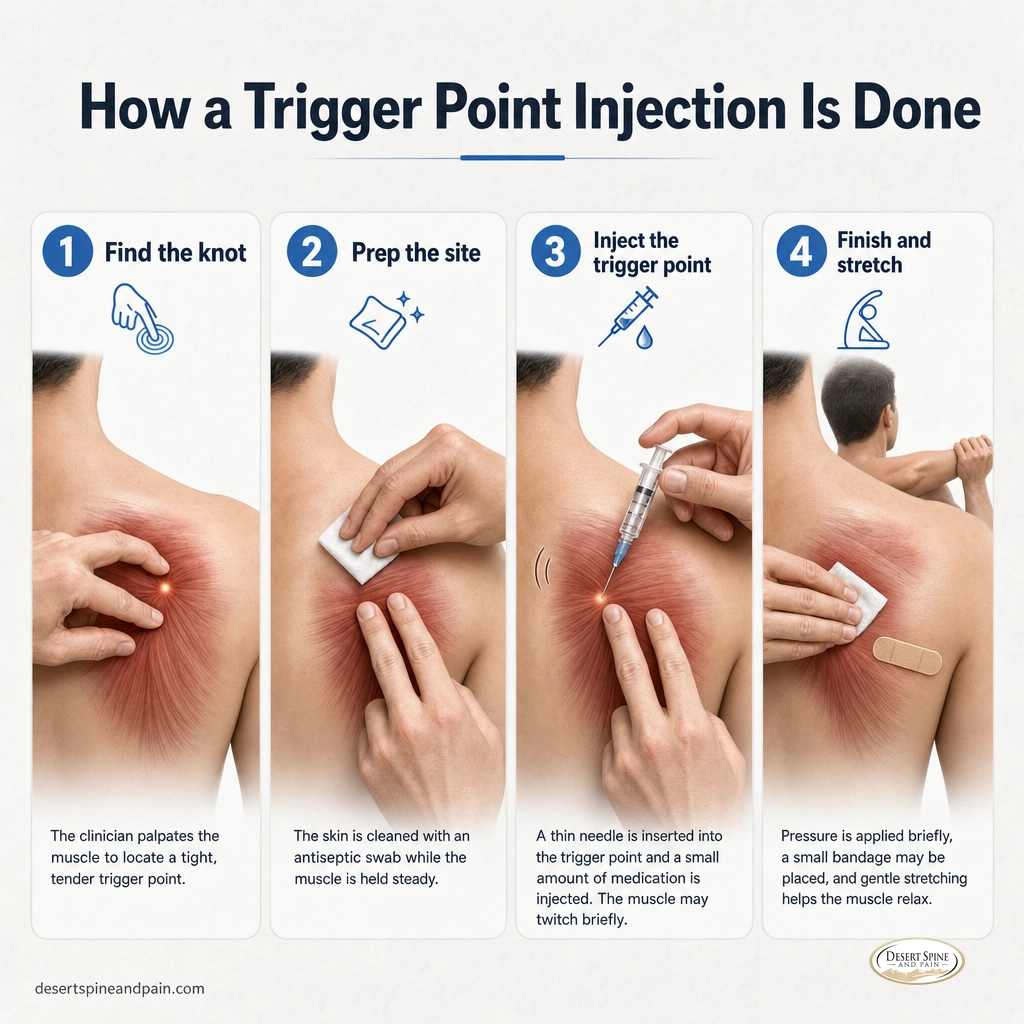
- Finding the trigger point. The physician presses along the muscle to locate the exact tender knot, often confirming it by the referred pain or a small muscle twitch when pressed.
- Preparing the site. The skin is cleaned, and the muscle is positioned so the trigger point can be held steady between the fingers.
- The injection. A thin needle is inserted into the knot. If an anesthetic is used, a small amount (about 0.2 mL) is placed once the needle is inside. The needle may be moved through the knot several times to elicit and then exhaust the muscle twitch, which is part of the therapeutic effect.
- Finishing up. The needle is withdrawn, pressure is held briefly to limit bruising, and a simple adhesive bandage is usually all that is needed.
Afterward, some soreness at the site for a few days is normal and expected. Gentle stretching of the treated muscle right after the injection can improve the result, while strenuous activity is best avoided for the first few days. Trigger point injections are generally avoided or approached with extra caution if you have a bleeding tendency or take blood thinners, are on daily aspirin, have an infection, or are allergic to the anesthetic, which is why a short medical review happens first.
Source: American Academy of Family Physicians: Trigger Point Management
Common Questions About Trigger Point Injection Steroids
Do all trigger point injections contain a steroid?
Which steroid is used in a trigger point injection when one is added?
Is a steroid or a local anesthetic better for a trigger point injection?
Are there risks to using a steroid in a trigger point injection?
How long does relief from a trigger point injection last?
Related Injection Terms
- Trigger point injection: a targeted injection into a painful muscle knot to break the pain cycle, with or without a steroid.
- Epidural steroid injection: a steroid injection around the spinal nerves, a true steroid injection, unlike most trigger point injections.
- Facet joint injection: an injection into a small spinal joint, often combining anesthetic and a corticosteroid.
- Joint injection: a corticosteroid or anesthetic injection into a joint to calm inflammation and pain.
- Sacroiliac joint injection: a targeted injection into the SI joint at the base of the spine.
- Nerve block: an anesthetic injection near a nerve to interrupt pain signals, sometimes with a steroid.
- Dry needling: a needle-only technique that treats a trigger point with no medicine, relying on the needle's mechanical effect.
Sources
Sources and Methodology
This guide summarizes established clinical references on trigger point injections and myofascial pain. The composition of the injectate (local anesthetic, saline, corticosteroid, or dry needling), the typical anesthetic choice and volume, the finding that the needle's mechanical effect drives much of the relief, and the muscle-toxicity concern with corticosteroids are drawn from the American Academy of Family Physicians review of trigger point management. The specific corticosteroids named (methylprednisolone, triamcinolone, dexamethasone) are the standard injectable corticosteroids used throughout musculoskeletal injection practice. This is educational information, not medical advice. Decisions about any injection should be made with a qualified physician after an in-person evaluation.