

What Not to Do After Trigger Point Injections: Aftercare and Recovery
After a trigger point injection, in short: do not jump into strenuous activity, forceful massage, or heat on the site for the first few days, and do not ignore spreading redness, fever, or worsening pain. Gentle movement, light stretching, ice, and rest are what help the treated muscle settle and heal.
You just left the office with a small bandage and a muscle that finally feels looser, and the natural question is simple: what should you avoid now so you do not undo the relief? A trigger point injection is a quick, low-downtime procedure, but the hours and days afterward still matter. A few common mistakes, like pushing straight into a hard workout or ignoring a warning sign, can leave you more sore than you needed to be. This guide walks through exactly what not to do after a trigger point injection, what actually helps, a realistic recovery timeline, and the red flags worth a phone call.
- Avoid strenuous activity, heavy lifting, and hard workouts for about three to four days while the muscle settles.
- Do not massage or press hard on the injection site, and hold off on heat for the first day or two; ice is better early on.
- Mild soreness or bruising is normal and usually fades within a few days; it does not mean the injection failed.
- Keep gently moving. Light walking and full range-of-motion stretches help more than complete rest.
- Call your doctor for spreading redness, fever, severe or worsening pain, or any breathing trouble after an upper-back or shoulder injection.

What's in This Guide
- A Quick Recap: What a Trigger Point Injection Does
- What Not to Do After a Trigger Point Injection
- What You Should Do: Simple Aftercare Steps
- Trigger Point Injection Recovery Timeline
- Side Effects and When to Call Your Doctor
- Getting Lasting Relief, Not Just a Quick Fix
- Common Questions
- Related Pain and Injection Topics
- Sources
A Quick Recap: What a Trigger Point Injection Does
A trigger point injection, or TPI, treats a painful muscle knot, the taut, tender band in a muscle that can refer pain elsewhere. A thin needle delivers a local anesthetic, sometimes with a small amount of corticosteroid, straight into the knot to interrupt the spasm and let the muscle release. Some injections use the needle alone, a technique called dry needling. It is an in-office procedure, a bandage goes on afterward, and most people walk out and resume normal activity the same day.
Because it is so quick, it is easy to assume there is nothing to think about afterward. There is, just not much. The treated muscle has been through a small, deliberate injury, and giving it the right conditions for a day or two is what turns short-term relief into a smoother recovery. If you want the full picture of the procedure itself, see our overview of trigger point injections at Desert Spine and Pain.
Source: American Family Physician: Trigger Points, Diagnosis and Management
What Not to Do After a Trigger Point Injection
Most of aftercare is common sense, but the specific don'ts below are the ones patients ask about most, because they are the easiest to get wrong. None of them are dramatic, and skipping them rarely causes harm, but following them keeps you more comfortable and protects the relief you just got.
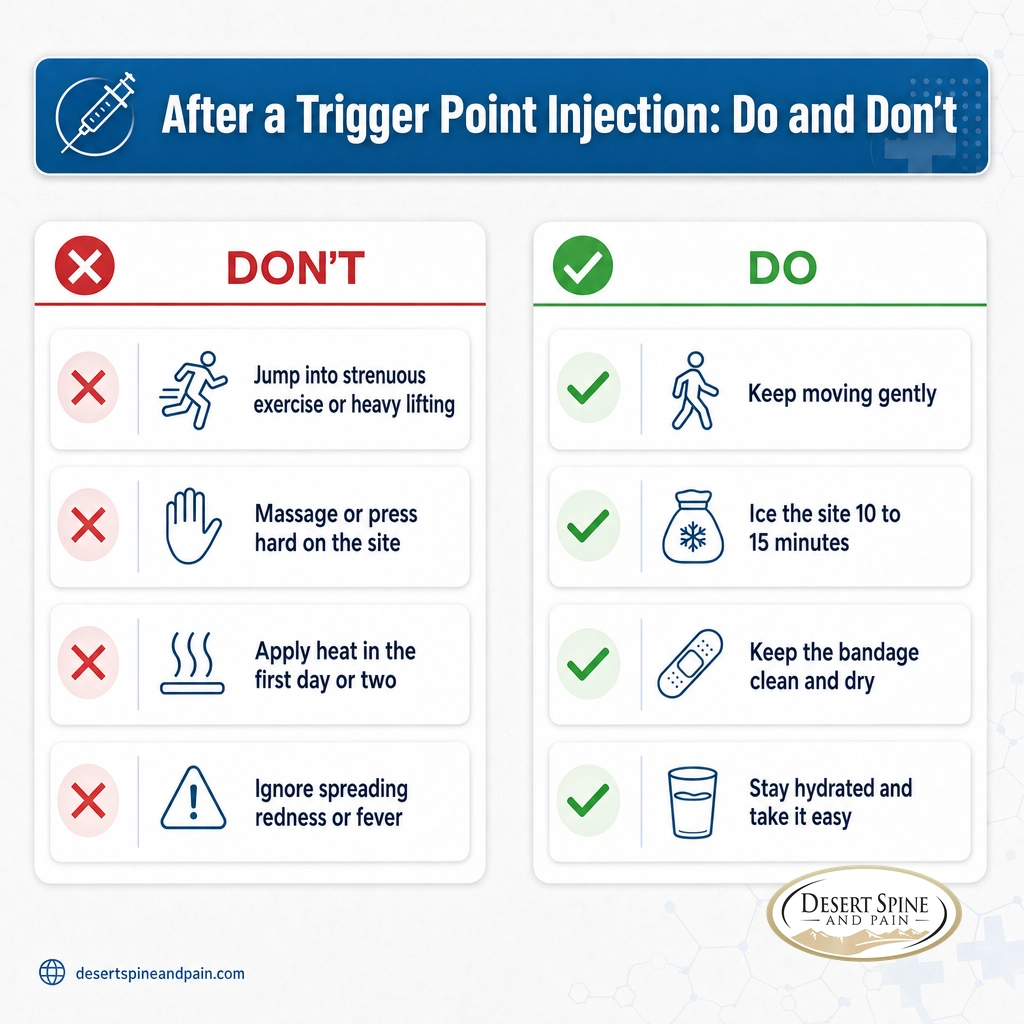
- Do not jump into strenuous activity. This is the big one. Hard workouts, heavy lifting, and high-impact activity in the first few days can aggravate the muscle that was just treated and leave you noticeably more sore. Clinical guidance is to stay active with gentle movement but avoid strenuous activity, especially in the first three to four days.
- Do not stay completely still, either. The opposite mistake is parking yourself on the couch and not moving the area at all. Gentle motion keeps the muscle from tightening back up. Light walking and moving the treated muscle through its range are encouraged right away.
- Do not massage or press hard on the site. It is tempting to rub a spot that still feels tender, but firm massage or digging into the injection site in the first day or two can increase bruising and irritation. Let it be, and keep your hands off the bandage.
- Do not apply heat right away. Early on, heat can increase swelling and bruising at the site. Reach for ice first, then switch to heat later in recovery once the initial tenderness has eased.
- Do not restart blood thinners or aspirin on your own. If you were told to pause aspirin or a blood thinner before the injection, do not resume it until your provider says so. Restarting too early can add to bleeding and bruising at the site.
- Do not drink alcohol or drive if you feel lightheaded. A small number of people feel briefly faint after any needle procedure. If you feel dizzy, sit or lie down until it passes, skip alcohol that day, and have someone else drive if you are not steady.
- Do not panic over post-injection soreness. New soreness at the site, or a deep-bruise feeling, is expected and is not a sign the injection failed. It typically settles within a few days.
- Do not expect instant or permanent relief every time. Some people feel better immediately, others over a day or two, and the muscle anesthetic can wear off before the lasting effect sets in. One injection also may not be the whole answer if an underlying problem keeps re-triggering the knot.
- Do not ignore the warning signs. Mild soreness is fine. Spreading redness, warmth, fever, drainage, or pain that keeps getting worse is not, and should prompt a call. More on that below.
Myth: "If I rest completely and do nothing, I'll heal faster." Not with a trigger point injection. The muscle responds best to gentle movement, not immobility. Lying still for days can let the knot tighten back up, which is the opposite of what the injection is meant to do. The goal is easy, regular motion, not bed rest and not a boot-camp workout.
Source: American Family Physician trigger point management guidance
What You Should Do: Simple Aftercare Steps
The flip side of the don'ts is a short, easy routine. None of this requires special equipment, and most of it takes a few minutes.
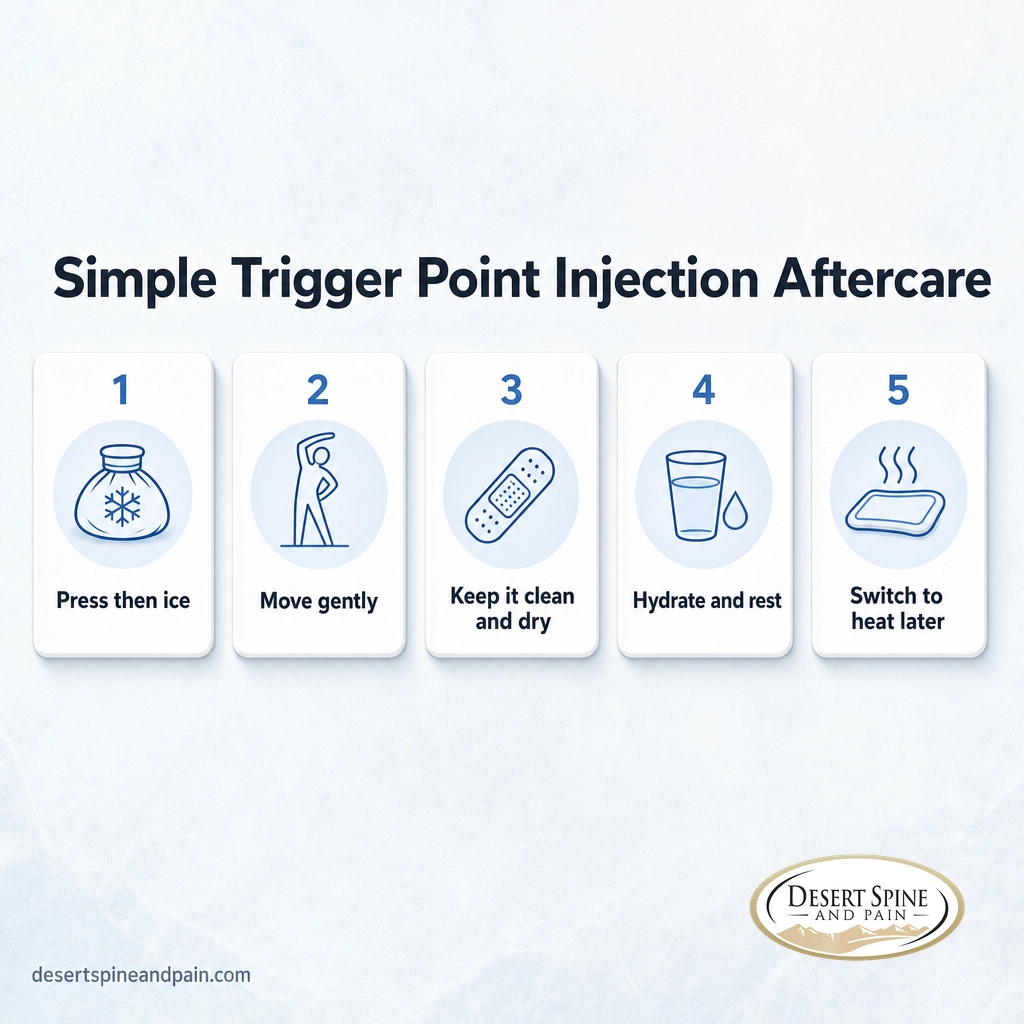
- Apply gentle pressure, then ice. Brief pressure right after the injection helps the site stop bleeding under the skin. For the next day or two, a cold pack for 10 to 15 minutes at a time eases soreness and limits bruising. Put a thin cloth between the pack and your skin.
- Move the muscle gently. Taking the treated muscle through its full range of motion soon after the injection can actually improve the result. Easy stretches and light walking, done without forcing anything, keep the area loose.
- Keep the site clean and dry. Leave the bandage on as directed, and keep the spot clean. A simple adhesive bandage is usually all that is needed. Avoid soaking it in a bath, pool, or hot tub for the first day.
- Stay hydrated and go easy. Drink water and plan a low-key rest of the day. Normal light activity, errands, desk work, a gentle walk, is completely fine.
- Switch to heat later. Once the first day or two has passed and the sharp tenderness is gone, gentle heat can help the muscle relax and keep it from stiffening.
- Jot down how you respond. Note when relief started, how strong it was, and how long it lasted. That information helps your provider fine-tune the plan if you need repeat injections.
Source: American Family Physician trigger point injection technique and aftercare | Desert Spine and Pain trigger point injection overview
Trigger Point Injection Recovery Timeline
Recovery from a trigger point injection is measured in days, not weeks. Knowing the rough arc keeps expectations realistic, so a normal sore spot on day one does not feel like a setback.
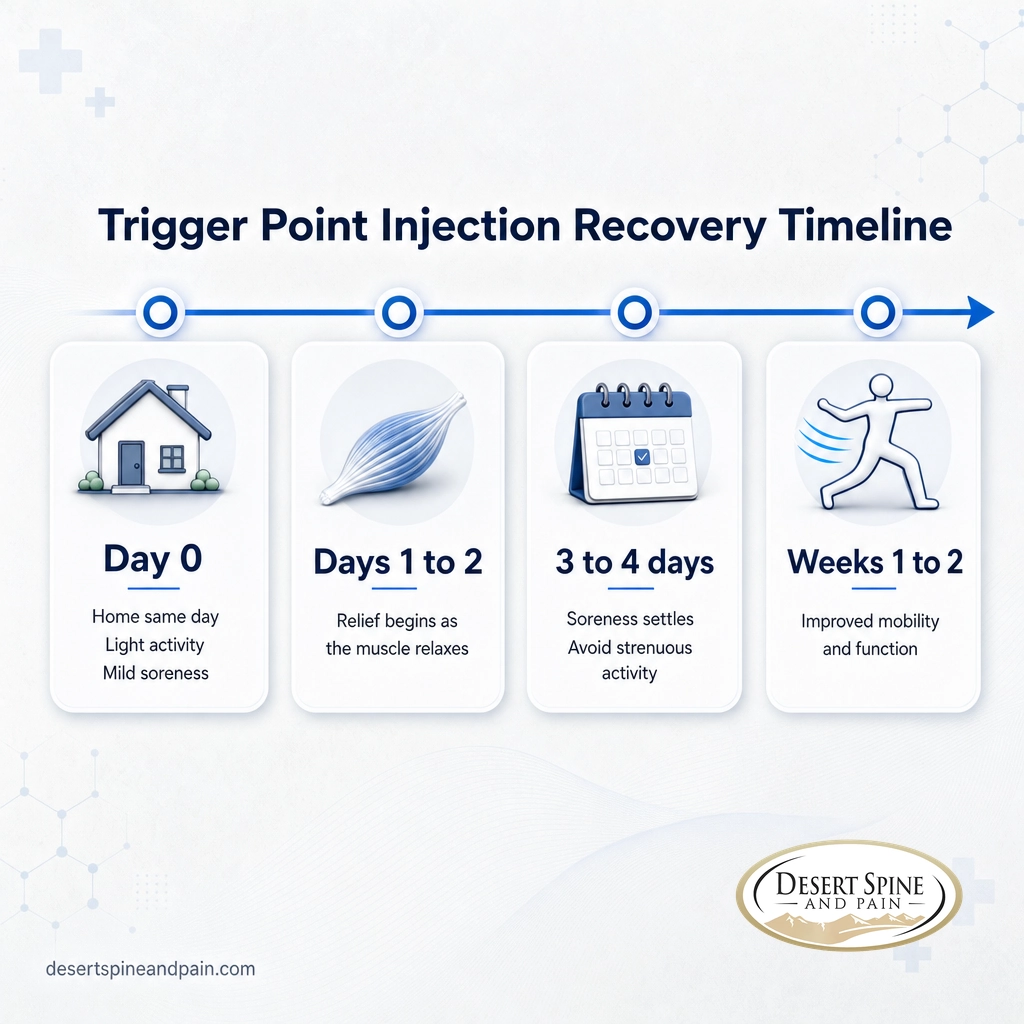
- Day 0 (injection day). You go home with a bandage and can resume normal, light activity the same day. Mild soreness at the site is common, and the local anesthetic may make the area feel numb or looser for a few hours.
- Days 1 to 2. As the muscle relaxes, many people notice pain relief beginning. Post-injection soreness, if you have it, is usually at its peak here and then starts to fade. Keep activity gentle and avoid hard exercise.
- First few days (about 3 to 4). This is the window to skip strenuous activity. Injection-site soreness generally resolves in this timeframe; repeat injections are typically not done until it does.
- Weeks 1 to 2. Mobility and function usually improve as the treated muscle stays released. This is a good time to build back into your normal routine, including any stretching or conditioning your provider recommended.
- Beyond. Relief can last weeks to months. If the knot returns because of an ongoing cause, injections can be safely repeated, often alongside a broader plan.
If you had dry needling without medication, expect the soreness part of this timeline to feel a bit stronger and last a little longer than an injection that included anesthetic. That is normal and not a cause for worry on its own.
Source: American Family Physician post-injection recovery guidance | Desert Spine and Pain recovery timeline for trigger point injections

Side Effects and When to Call Your Doctor
Trigger point injections are considered safe, and serious problems are rare. The common side effects are minor and short-lived. The key skill is telling a normal reaction apart from a warning sign, so the table below lays them side by side.
| Normal and expected | Call your doctor |
|---|---|
| Mild soreness or a bruised feeling at the site for a few days | Pain that is severe or keeps getting worse instead of easing |
| A small bruise or spot of redness right where the needle went in | Redness or warmth that spreads, drainage, or a fever (possible infection) |
| Brief lightheadedness right after the needle | Fainting, or dizziness that does not pass when you rest |
| The treated area feeling numb or loose for a few hours | Any shortness of breath or chest discomfort after an upper-back or shoulder injection |
| Relief that takes a day or two to fully set in | A rash, swelling, or trouble breathing that could signal an allergic reaction |
A few of the right-hand items deserve a note. Infection is uncommon but is the main reason to keep the site clean and to watch for spreading redness or fever. Bleeding and bruising are more likely if you are on a blood thinner, which is why timing those medications around the injection matters. And when injections are placed near the chest wall, over the upper back or shoulder, there is a small, well-recognized risk of affecting the lung (a pneumothorax); new shortness of breath or chest pain afterward should be checked promptly. These events are rare, but knowing them means you will not second-guess a normal sore muscle while still catching the things that matter.
Source: American Family Physician: complications of trigger point injection
Getting Lasting Relief, Not Just a Quick Fix
A trigger point injection is excellent at quieting an angry muscle knot, but a knot usually forms for a reason: posture, an underlying spine problem, an old injury, or muscle overload. If the cause is still there, the knot can come back. That is not a failure of the injection; it is a sign the plan needs another layer.
At Desert Spine and Pain, the approach is to use the least invasive effective treatment and to look for what is driving the pain in the first place. A trigger point injection often works best as one part of a broader plan that can include guided stretching and conditioning, other targeted spine and joint injections, and a full look at your pain management options. The practice is led by Dr. David L. Greenwald, MD, FACS, a board-certified spine surgeon and neurosurgeon, so if a muscle knot turns out to be the surface symptom of a deeper issue, the evaluation and the care are under one roof.
Learn about trigger point injections at Desert Spine and Pain
Explore our pain management treatments
Book a consultation for lasting pain relief
Common Questions About Trigger Point Injection Aftercare
How long should I rest after a trigger point injection?
Can I exercise or work out after a trigger point injection?
Is soreness normal after a trigger point injection?
Should I use ice or heat after a trigger point injection?
When should I call the doctor after a trigger point injection?
Related Pain and Injection Topics
- Facet joint injections: targeted injections for pain coming from the small joints of the spine, a close cousin of the trigger point injection.
- Epidural steroid injections: injections that calm inflamed nerves in the spine, often used for sciatica and radiating pain.
- Spine and joint injections: the full menu of interventional pain injections and how they compare.
- Pain management: conservative and interventional options for chronic neck and back pain.
- Dr. David L. Greenwald, MD, FACS: the board-certified spine surgeon and neurosurgeon who leads the practice.
Sources
Sources and Methodology
This guide summarizes established clinical references on trigger point injections and standard post-procedure care. Timeframes are presented as general ranges, not individual predictions, and aftercare instructions from your own provider always take precedence over general guidance. This is educational information, not medical advice. If you have questions about your recovery or notice a warning sign, contact your care team.