
Lumbar Spinal Stenosis Surgery Success Rate: What the Data Shows
Lumbar spinal stenosis surgery works for most people, but "success rate" is not a single number. Depending on how researchers define it, published success runs from about two-thirds to three-quarters of patients, and the landmark trials show decompression clearly beats non-surgical care for leg pain, walking, and function. The gap between the high numbers and the low ones is almost entirely about definitions, timing, and who performs the operation.
- Spinal stenosis is the leading reason for spine surgery in adults over 65, affecting more than 200,000 U.S. adults.
- In one 2024 cohort, 73.8 percent of patients cleared the disability-improvement threshold and 75.4 percent were satisfied, while a stricter three-part definition put success at 65.6 percent.
- The SPORT randomized trial showed surgery maintained a clear advantage over non-surgical care through 4 years for pain, function, and disability.
- A landmark long-term study found success held near two-thirds of patients at 5 years, with lateral recess stenosis doing less well than central stenosis.
- Only 18 percent of patients had a second operation within 8 years; 42 percent of those reoperations occurred within the first 2 years.
- Reoperation was 16.3 percent after open laminectomy versus 5.8 percent after minimally invasive laminotomy in a 37-study meta-analysis.
- For stenosis without instability, adding fusion does not improve outcomes over decompression alone, so a bigger operation is not automatically a better one.

What's in This Guide
1What "Success Rate" Actually Means
When a surgeon quotes a success rate for lumbar stenosis surgery, the number hides a definition. One study can report three very different success rates from the exact same patients, depending on whether success means a patient-reported improvement, confirmation on imaging, personal satisfaction, or all three at once. This is the single biggest reason published numbers seem to disagree.

Notice that all three figures come from one 2024 study of the same patients. Loosen the definition to patient satisfaction and you get 75 percent; tighten it to a strict composite and you get 66 percent. Neither number is wrong. They answer different questions. When you compare surgery success rates, always ask which definition and which follow-up point a number refers to before you trust it.
Three questions make any success statistic meaningful: How is success defined (symptom relief, imaging, satisfaction, or a strict combination)? How far out was it measured (6 months reads better than 8 years)? And who was operated on (lateral recess and multilevel cases behave differently than a single central level)? A number without those three anchors is marketing, not evidence.
Source: Success predictors of decompressive treatment for lumbar stenosis, 2024
2How Often Surgery Relieves Symptoms
Set definitions aside and ask the question patients actually care about: does the operation relieve the leg pain, numbness, and walking limitation of stenosis? Here the highest-quality evidence is reassuring and consistent. The Spine Patient Outcomes Research Trial (SPORT), one of the largest randomized surgical trials in spine care, compared decompression with non-surgical treatment across 13 U.S. centers.
In the SPORT as-treated analysis, the surgical group improved more than the non-surgical group by roughly 12.6 points on bodily pain, 8.6 points on physical function, and 9.4 points on the Oswestry Disability Index, differences that are both statistically significant and clinically meaningful. For leg-dominant symptoms and walking tolerance in particular, decompression is one of the more predictable operations in spine surgery.
Learn about laminectomy decompressionSource: SPORT 4-year stenosis results, Spine 2010 | Lumbar spinal stenosis review, BMJ 2016 | Effectiveness of surgery for LSS, systematic review
3Long-Term Durability and the 8-Year Picture
A good result at six months is not the same as a good result at five or ten years. Stenosis is a degenerative process, so durability matters. The long-term evidence is encouraging but honest about its limits.
The 1998 study is older, so its figures are framed as historical context, but they are corroborated by modern cohorts and remain one of the cleanest long-term looks at laminectomy durability. The 8-year SPORT data carry an important honesty: so many non-surgical patients eventually chose surgery, and sicker patients were lost to follow-up, that the long-term averages likely understate surgery's true effect rather than overstate it. The signal across every timeframe is the same: most well-selected patients keep their relief for years.
For most patients with stenosis, a short trial of conservative care first does not sabotage surgical outcomes. SPORT patients had symptoms for at least 12 weeks before enrolling and still did well with surgery. The real exceptions are red-flag symptoms such as progressive weakness, numbness in the groin, or loss of bowel or bladder control, which are surgical emergencies. Those aside, there is usually time to try non-surgical care and make an unhurried decision.
Source: Long-term follow-up of laminectomy for lumbar stenosis, J Neurosurg 1998 | SPORT 8-year reoperation subanalysis, Spine 2016
4Reoperation: How Often and When
One of the most useful ways to read "success" is its opposite: how often do patients come back for another operation? The SPORT 8-year subanalysis gives the clearest answer for lumbar stenosis, and the picture is better than many patients fear.
Two takeaways matter here. First, 82 percent of patients never needed a second operation over eight years. Second, the reoperations that do happen cluster early, which means a patient who is doing well at two or three years is statistically likely to keep doing well. That front-loaded pattern is also why the first surgery being done correctly, at the right level, by an experienced surgeon, matters so much.
Explore Coflex interspinous decompressionSource: Risk factors for reoperation after lumbar stenosis surgery, SPORT, Spine 2016

5Does the Operation Type Change the Odds?
Patients often assume a bigger operation means a more thorough fix and therefore a higher success rate. The data say the opposite is frequently true: for stenosis, matching the operation to the anatomy, and keeping it as small as the problem allows, protects the long-term numbers.
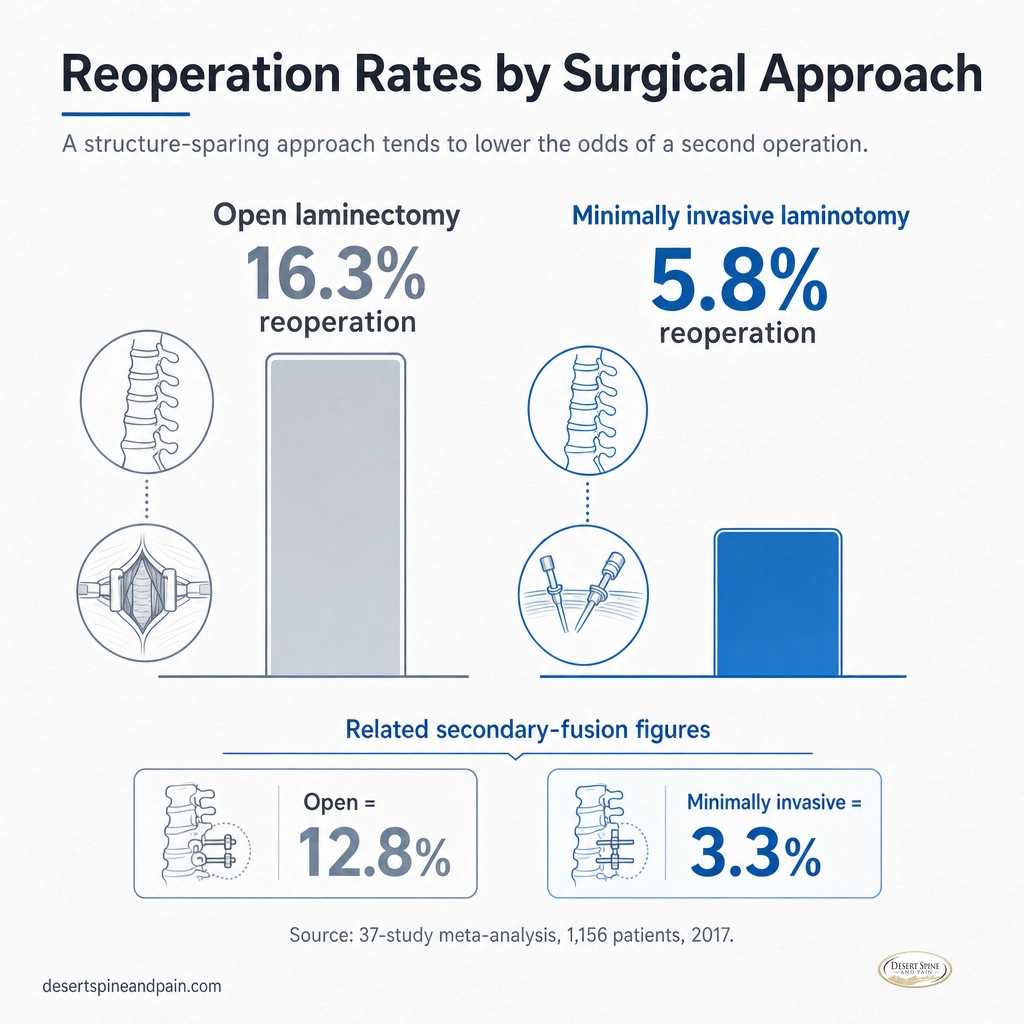
By preserving more of the muscle and the stabilizing midline structures, minimally invasive decompression appears to leave the spine less likely to become unstable and need a later fusion. That is the mechanism behind the lower reoperation and fusion rates above. The caveat is real: this evidence is mostly from lower-tier studies, and not every stenosis is a candidate for a minimally invasive approach. The point is not that one technique always wins, but that the choice should be driven by the anatomy and made by a surgeon fluent in the full range.
For stenosis without instability or deformity, high-quality evidence finds no outcome advantage from adding fusion to decompression, while fusion adds operating time, recovery, hardware, and cost. Fusion has a clear role when there is genuine instability or slippage, but reflexively adding it does not raise the success rate. A thorough decompression that relieves the nerve pressure is the goal, not the largest possible operation.
Source: Minimally invasive versus open decompression meta-analysis, Neurosurgery 2017 | SPORT decompression outcomes, Spine 2010
6What Predicts a Good Result
Success is not random. The research points to patient and anatomical factors that consistently shift the odds, and most of them can be assessed before surgery is ever scheduled.
| Factor | Effect on the Odds | Source |
|---|---|---|
| Severe preoperative neuropathic (nerve) leg pain | Predicts higher success | Krutko 2024 |
| Central stenosis | Does better than lateral recess | Javid 1998 |
| Correct level and accurate diagnosis | Critical to relief | SPORT and reviews |
| Minimally invasive, structure-sparing decompression | Lower reoperation and fusion | Schöller 2017 |
| Instability or deformity present | May need added fusion | Systematic reviews |
| No baseline neurological deficit | Associated with reoperation | Gerling 2016 |
The pattern is clear. Patients with clear nerve-compression symptoms that match the imaging, operated on at the right level, tend to do best. That is why the evaluation matters as much as the operation. Desert Spine and Pain is led by Dr. David L. Greenwald, MD, FAANS, FACS, dual board-certified as a spine surgeon and a neurosurgeon, which brings a least-invasive-first philosophy and a precise read of where the pain is actually coming from. The practice also works closely with personal injury attorneys, providing 24/7 concierge response and thorough documentation for injured clients whose recovery depends on getting the first operation right.
Combining the reoperation data shows how much the approach matters. Open laminectomy carried a 16.3 percent reoperation rate and a 12.8 percent secondary fusion rate, while minimally invasive laminotomy carried 5.8 percent and 3.3 percent for the same measures (Schöller 2017). That is close to a three-fold difference in the odds of a second operation, for the same underlying condition. Layered on top of the finding that added fusion does not improve stenosis outcomes without instability, the data point one direction: the least-invasive decompression that fully relieves the nerve tends to protect the long-term success number. The spread is not luck, it reflects technique and surgical judgment. Calculation and interpretation original to Desert Spine and Pain.
Source: Success predictors of decompressive treatment, 2024 | Reoperation risk factors, SPORT, Spine 2016
Summary Table: Stenosis Surgery Success Statistics
| Statistic | Figure | Source | Year |
|---|---|---|---|
| Patients clearing ODI improvement threshold | 73.8% | Krutko et al. | 2024 |
| Patient satisfaction with surgery | 75.4% | Krutko et al. | 2024 |
| Strict composite success (improvement + imaging + satisfaction) | 65.6% | Krutko et al. | 2024 |
| Surgical advantage over non-surgical care maintained through | 4 years | SPORT (Weinstein) | 2010 |
| SPORT bodily pain treatment effect (as-treated) | +12.6 pts | SPORT (Weinstein) | 2010 |
| SPORT physical function treatment effect | +8.6 pts | SPORT (Weinstein) | 2010 |
| SPORT disability (ODI) treatment effect | -9.4 pts | SPORT (Weinstein) | 2010 |
| Success at 1 year after laminectomy | ~70% | Javid & Hadar | 1998 |
| Sustained improvement at 5 years | ~2 in 3 | Javid & Hadar | 1998 |
| Reoperation within 8 years | 18% | Gerling et al., SPORT | 2016 |
| Reoperations occurring within first 2 years | 42% | Gerling et al., SPORT | 2016 |
| Reoperation after open laminectomy | 16.3% | Schöller et al. | 2017 |
| Reoperation after minimally invasive laminotomy | 5.8% | Schöller et al. | 2017 |
| Secondary fusion after open laminectomy | 12.8% | Schöller et al. | 2017 |
| Secondary fusion after minimally invasive laminotomy | 3.3% | Schöller et al. | 2017 |
| Leading indication for spine surgery, age 65+ | Stenosis (#1) | BMJ (Lurie) | 2016 |
| Added fusion vs decompression alone (no instability) | No outcome gain | SPORT and reviews | 2010-2016 |
Frequently Asked Questions
What is the success rate of lumbar spinal stenosis surgery?
How long do the results of lumbar decompression surgery last?
How often is a second spine surgery needed after stenosis decompression?
Is minimally invasive stenosis surgery better than open laminectomy?
Does adding spinal fusion improve stenosis surgery success?
Methodology & Sources
How we compiled these statistics
Every figure traces to a Tier 1 primary source: randomized controlled trials, peer-reviewed systematic reviews and meta-analyses, and long-term prospective cohorts. Success rates are reported with their definitions attached, because the same patients can yield different success numbers depending on whether success means symptom relief, imaging confirmation, satisfaction, or a strict combination. Ranges reflect differences in definition, follow-up length, and patient selection rather than disagreement about the value of surgery for well-selected patients. All figures describe populations, not any individual.
Primary sources referenced:
- Krutko et al., Success predictors of decompressive surgical treatment for lumbar degenerative spinal canal stenosis, 2024
- Weinstein JN et al., Surgical versus Nonoperative Treatment for Lumbar Spinal Stenosis: Four-Year Results of the SPORT, Spine, 2010
- Gerling MC et al., Risk Factors for Reoperation in Patients Treated Surgically for Lumbar Stenosis: 8-Year SPORT Subanalysis, Spine, 2016
- Schöller K et al., Lumbar Spinal Stenosis Associated With Degenerative Spondylolisthesis: Minimally Invasive vs Open Decompression meta-analysis, Neurosurgery, 2017
- Javid MJ, Hadar EJ, Long-term follow-up review of patients who underwent laminectomy for lumbar stenosis, Journal of Neurosurgery, 1998
- Lurie J, Tomkins-Lane C, Management of lumbar spinal stenosis, BMJ, 2016
- Effectiveness of Surgery for Lumbar Spinal Stenosis: A Systematic Review and Meta-Analysis, 2015
This article is educational and is not individual medical advice. For guidance specific to your spine condition, consult a qualified spine surgeon. No surgical outcome can be guaranteed.
Journalists and researchers may cite these statistics with attribution to Desert Spine and Pain and a link to this page. Please attribute the underlying figures to their original Tier 1 sources as listed above. For expert commentary on lumbar spinal stenosis surgery outcomes from a board-certified neurosurgeon and spine surgeon, contact Desert Spine and Pain at (602) 566-9500.