
Do Creams Help Sciatica Pain? What the Evidence Shows
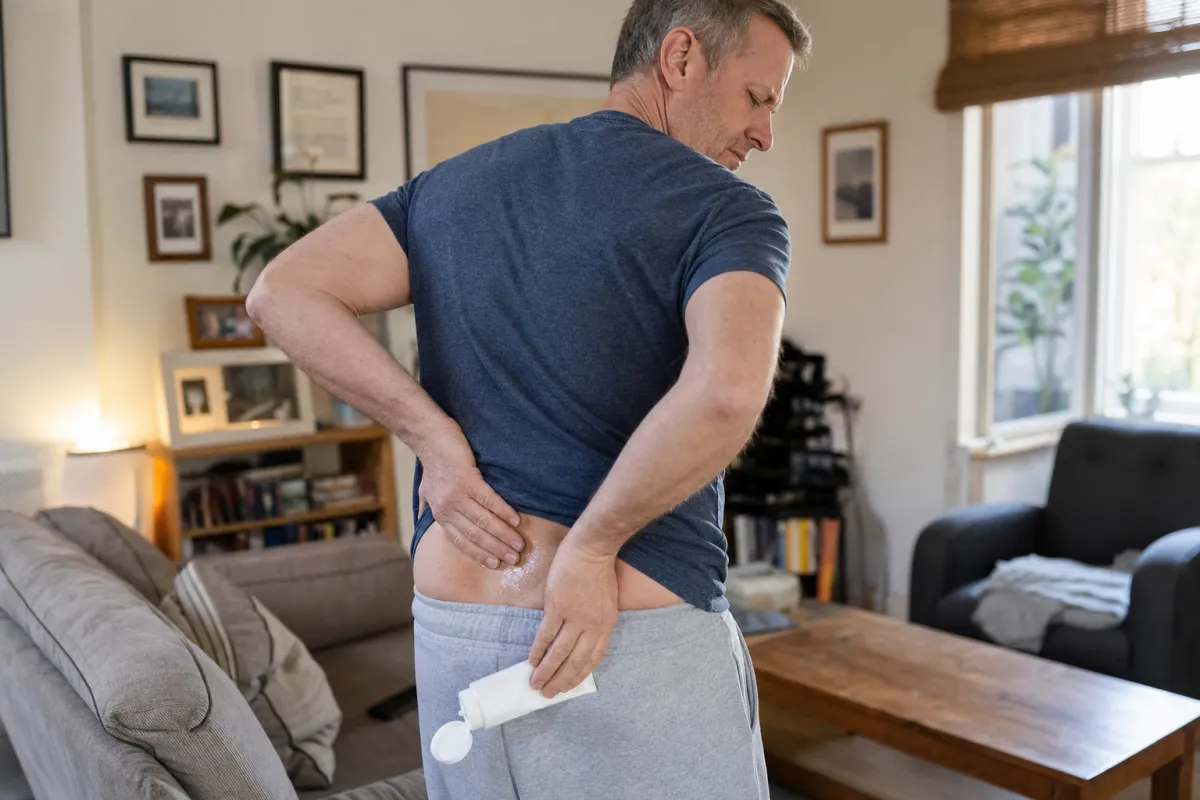
If you have searched for the best cream for sciatica pain, you have probably found endless product lists and very few straight answers. Here is the honest one: no cream is proven to treat sciatica, because the pain starts at a nerve root deep in your spine and creams only reach the skin. Some topicals can still take the edge off the muscle soreness that rides along with sciatica, so they have a small, honest role. This guide explains how each type of cream works, what the research actually shows, and the treatments that address the real cause.
Quick definition. A topical cream for sciatica is an over-the-counter or prescription gel rubbed onto the skin to ease pain. Creams can calm surface muscle soreness and give brief comfort, but none is proven to treat the compressed nerve root behind true sciatica, which sits too deep for a cream to reach.
- No cream treats sciatica itself. The pain comes from a nerve root in the spine; creams act only on skin and surface tissue.
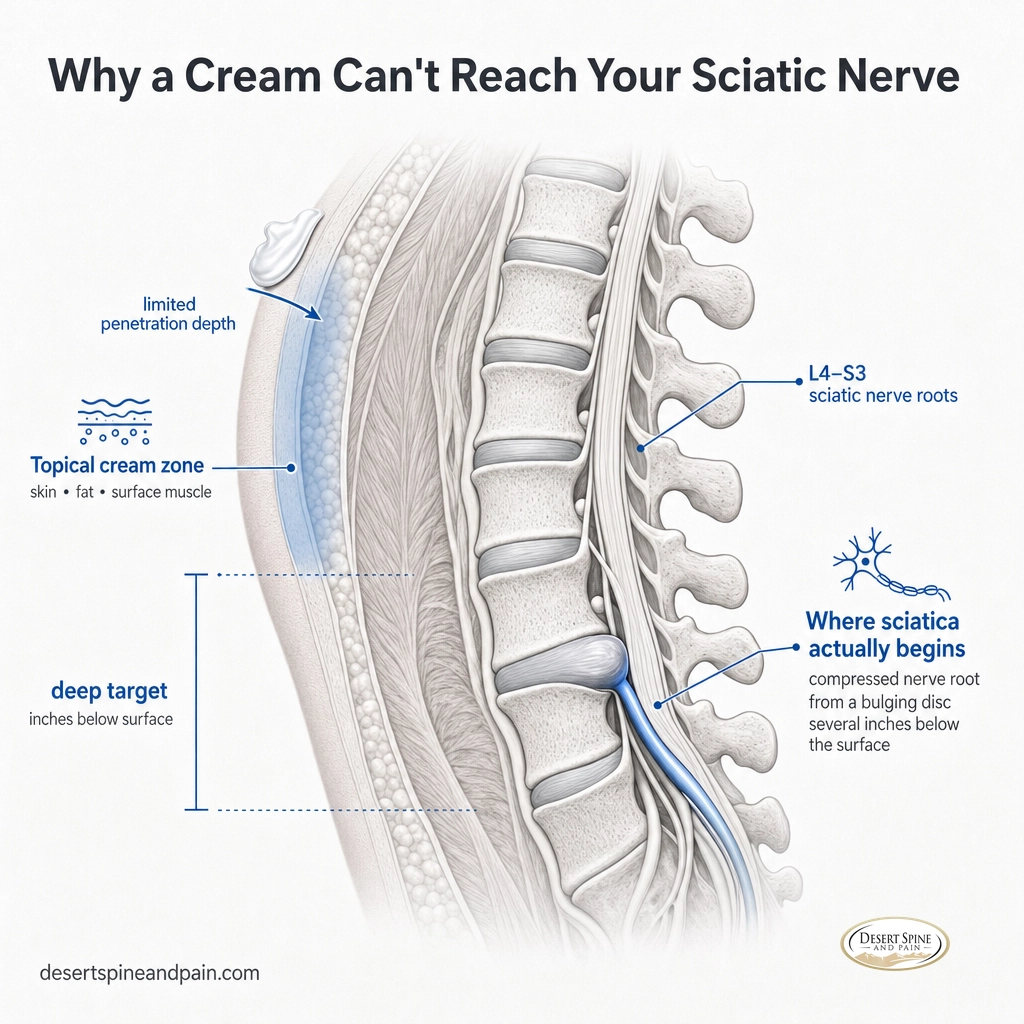
- The sciatic nerve forms from the L4 to S3 nerve roots, usually compressed deep inside the spinal canal, well out of a cream's reach.
- Topical NSAIDs (diclofenac gel) are proven for knee and hand osteoarthritis, not for nerve-root pain.
- Capsaicin's real evidence is for the clinic-applied 8% patch in shingles nerve pain, not the drugstore cream and not sciatica.
- Topical lidocaine has no good-quality trial evidence for neuropathic pain.
- Creams are reasonable for short-term comfort, but they are not a substitute for a real diagnosis and treatment plan.
- Roughly 80% to 90% of sciatica improves without surgery when the right care starts early.

What's in This Guide
- The Short Answer: Do Creams Help Sciatica?
- How Topical Pain Creams Actually Work
- What the Evidence Shows, Cream by Cream
- When a Cream Is a Reasonable Option
- What Actually Treats Sciatica
- Red Flags: When to Stop and See a Doctor
- Every Option at a Glance
- Frequently Asked Questions
- Methodology and Sources
The Short Answer: Do Creams Help Sciatica?
Creams can make the surrounding area feel better for a little while. They do not fix sciatica. That distinction is the whole story, and it comes down to where the pain begins.
Sciatica is not a muscle ache in your skin. It is radicular pain, meaning it starts at a spinal nerve root and travels down the path of the sciatic nerve into the buttock and leg. The sciatic nerve is built from the nerve roots at levels L4 through S3, and the trouble usually begins where a herniated disc, bone spur, or narrowed canal presses on one of those roots inside the spine. That spot is often several inches below the surface of your back.
A cream rubbed on your lower back soaks into skin, fat, and a thin layer of muscle. It cannot physically reach a nerve root sitting deep in the spinal canal. So when a product promises to relieve sciatica, the most it can honestly do is ease the muscle tension and surface discomfort that often accompany a sciatica flare, or create a sensation that distracts from the pain for an hour or two. That has value as comfort. It is not treatment. For the full picture of how common this condition is and how it behaves, see our sciatica statistics.
Source: StatPearls (Sciatica)
Explore the conditions we treatHow Topical Pain Creams Actually Work
Nearly every product marketed for sciatica falls into one of four ingredient families. Each works by a different mechanism, and understanding them explains both what a cream can do and what it cannot.
1. Counterirritants (menthol, camphor, methyl salicylate)
These are the cooling or warming rubs you can smell from across the room. They work by creating a strong surface sensation that competes with the pain signal, a bit like scratching an itch next to a bruise. The relief is real but shallow and brief, and it fades as the sensation does. They do nothing to the nerve root.
2. Topical NSAIDs (diclofenac gel)
These deliver an anti-inflammatory drug through the skin into the tissue just below. The goal is to calm inflammation locally while keeping the drug out of your stomach and bloodstream, which lowers the digestive risks of NSAID pills. They are best suited to joints and muscles close to the surface.
3. Capsaicin (the compound in chili peppers)
Capsaicin works by overstimulating and then quieting the pain-sensing nerve endings in the skin. Over-the-counter creams are low strength and must be applied several times a day. A separate high-concentration 8% patch is a prescription product applied in a medical setting, and it is a different treatment with far stronger evidence behind it.
4. Topical anesthetics (lidocaine)
Lidocaine numbs the nerve endings in the skin directly. It is sold as a 4% over-the-counter cream and a 5% prescription patch. Like the others, it acts on surface nerves, not on a compressed root deep in the spine.
Myth: "If the label says nerve pain, the cream must reach the nerve."
Marketing language blurs an important line. A cream can calm the tiny nerve endings in your skin, and that is technically nerve activity. But sciatica comes from a nerve root pinched inside your spinal column, which no topical product can touch. A label that says "for nerve pain" is describing surface nerve endings, not the deep root causing your leg pain. Read the mechanism, not the marketing.
Source: Cochrane overview of topical analgesics (2017)
See conservative and non-invasive treatment optionsWhat the Evidence Shows, Cream by Cream
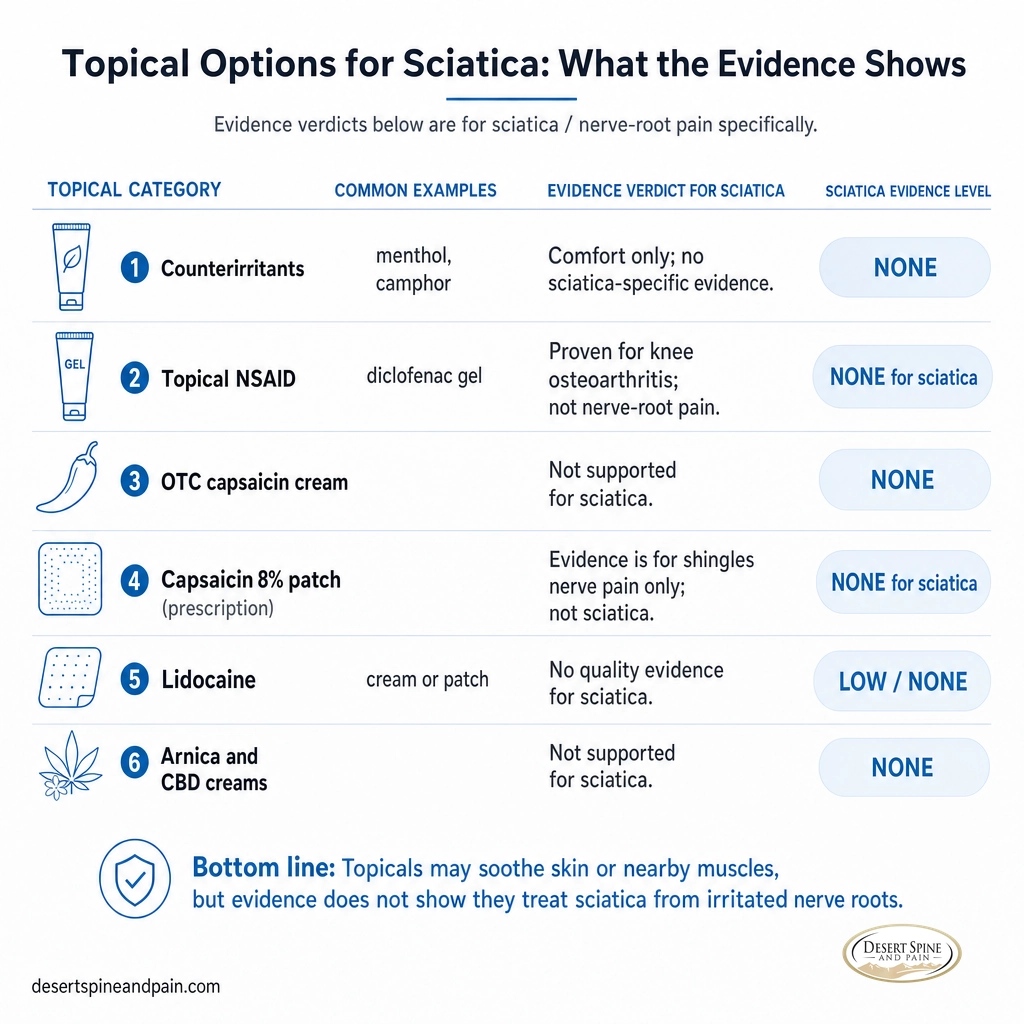
Here is where most "best cream" lists go quiet. When you check the actual clinical research, almost none of it was done on sciatica. The topicals that have genuine evidence earned it in other conditions, and that matters when you are deciding what to expect.
Topical NSAIDs: proven for arthritis, not nerve pain
The strongest evidence for any topical is for diclofenac gel in osteoarthritis of the knee and hand. A Cochrane systematic review found that about 6 in 10 people with knee osteoarthritis got meaningful pain relief over 6 to 12 weeks, compared with about 5 in 10 using the gel base alone. That is a real but modest effect, and the review noted little good evidence for topical NSAIDs in any other kind of chronic musculoskeletal pain.
Osteoarthritis is a surface joint problem. Sciatica is a deep nerve problem. The evidence for diclofenac does not transfer, and no reliable trial supports it for sciatic nerve pain.
Source: Cochrane: Topical NSAIDs for chronic musculoskeletal pain (2016)
Capsaicin: the patch is the real treatment, not the cream
Capsaicin has meaningful evidence, but it belongs to the high-concentration 8% patch, not the drugstore cream. A Cochrane review found moderate-quality evidence that the 8% patch gives moderate or better relief to a minority of people with postherpetic neuralgia, the nerve pain that follows shingles. The number needed to treat was roughly 7 to 9, meaning about one in seven to nine people treated gained real benefit, and that patch must be applied in a clinic because of the intense initial burning.
That evidence is for shingles nerve pain, not sciatica, and it is for a supervised prescription patch, not the cream on the pharmacy shelf. The low-strength over-the-counter creams do not carry the same support.
Source: Cochrane: Topical high-concentration capsaicin for neuropathic pain (2017)
Topical lidocaine: little quality evidence at all
A Cochrane review of topical lidocaine for neuropathic pain found no good-quality randomized trial evidence to recommend it, rating the available evidence as very low quality because the studies were small and poorly reported. Some people report relief, but the research base is too thin to call it effective, and none of it addresses sciatica.
Source: Cochrane: Topical lidocaine for neuropathic pain (2014)
Counterirritants, arnica, and CBD: comfort, not correction
Menthol and camphor rubs, arnica, and CBD creams are widely sold for back and nerve pain. They are generally low risk, and the cooling or warming feeling can be pleasant during a flare. But none has credible evidence for treating sciatica, and claims that they reduce nerve inflammation deep in the spine are not supported. Treat them as comfort measures only.
Explore interventional pain managementWhen a Cream Is a Reasonable Option
None of this means you should throw away the tube in your cabinet. It means using it for the right job. A topical can be a sensible part of your routine when the expectations are honest.
A cream makes sense when your main goal is short-term comfort during a flare, when the sore, tight muscles around the painful area are part of what bothers you, and when you understand you are managing symptoms rather than treating the cause. A topical NSAID or a simple menthol rub is low risk for most adults, does not interact much with other medicines, and can be paired with gentle movement and the other steps your clinician recommends.
A cream is the wrong tool when it becomes a reason to wait. Leaning on a topical for weeks while the leg pain continues, worsens, or spreads is the real danger, because sciatica is more treatable early. National guidance from the UK's National Institute for Health and Care Excellence (NICE) emphasizes staying active and self-management for sciatica, is cautious even about oral anti-inflammatory pills given their limited benefit and real risks, and advises against several pain medicines that were once common for sciatica. The theme across modern guidance is clear: time and the right early care matter more than any product on a shelf.
Desert Spine and Pain Analysis: The Hidden Cost of "Just Trying Another Cream"
The honest math on topicals is simple. Even the best-studied cream, diclofenac for arthritis, helps only about one extra person in ten beyond the gel base, and that evidence is not even for sciatica. Meanwhile, sciatica grows harder to treat the longer a pinched nerve stays irritated. So the weeks spent cycling through creams are rarely free. They are weeks the underlying problem keeps going unaddressed. A cream as comfort while you pursue a real plan is reasonable. A cream instead of a plan is a quiet setback.
Interpretation of the topical-NSAID response rate against the natural history of sciatica. Calculation and interpretation original to Desert Spine and Pain. Sources: Cochrane; NICE NG59.
Source: NICE NG59: Low back pain and sciatica recommendations
Meet Dr. Greenwald: spine surgeon and neurosurgeon
What Actually Treats Sciatica
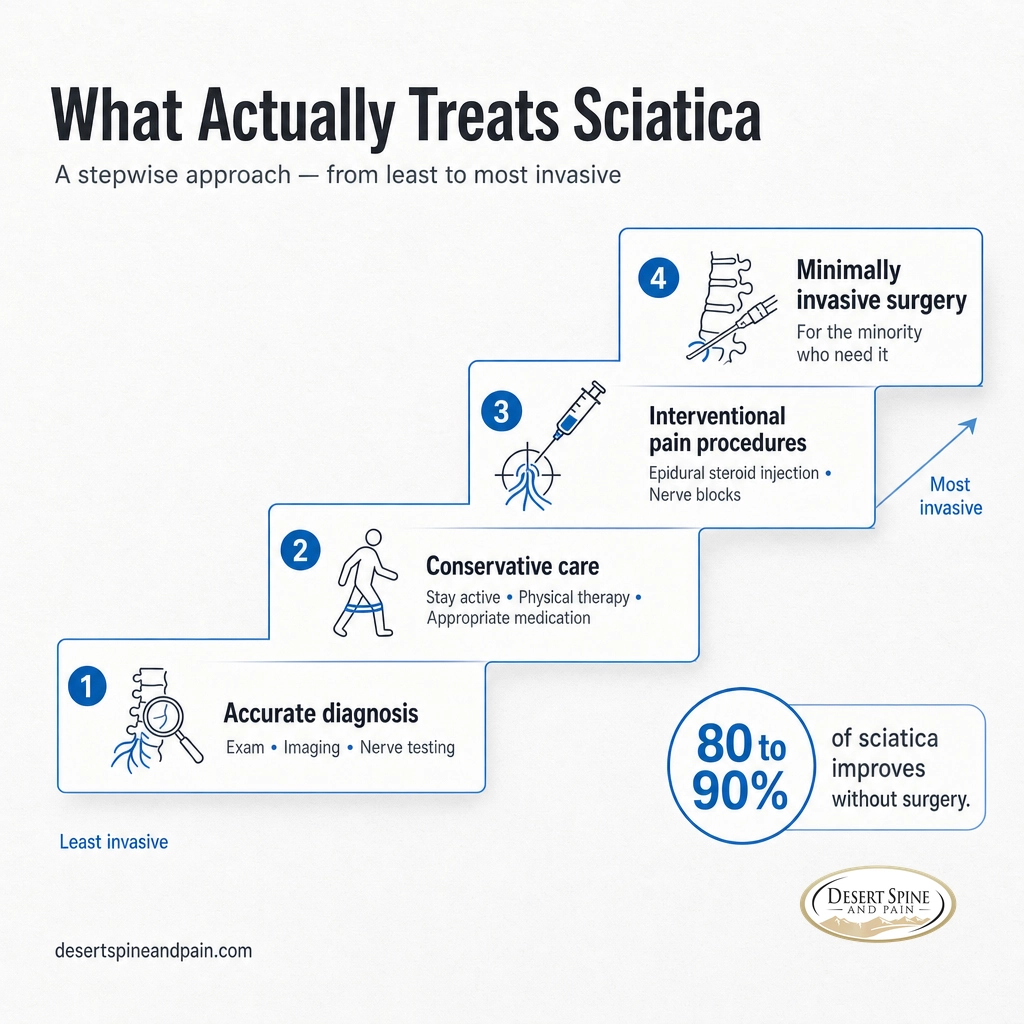
The good news behind all of this is that sciatica usually responds well to care that targets the source, and most people never need surgery. Effective treatment follows a least-invasive-first ladder, matched to how severe and how persistent the pain is.
Step 1: An accurate diagnosis
Because sciatica has several possible sources, from a herniated disc to spinal stenosis, the first step is identifying which nerve root is affected and why. A proper exam, and imaging or nerve testing when needed, turns "my leg hurts" into a specific, treatable problem. You can read about diagnostic nerve testing and what it reveals.
Step 2: Conservative care
Most people start here, and most people improve here. Staying active within comfort, guided rehabilitation and physical therapy, and appropriately chosen medication address the irritated nerve and the muscles protecting it. This is where a comfort cream can play its small supporting role.
Step 3: Targeted interventional pain procedures
When pain persists, treatments delivered right to the source can calm an inflamed nerve root. An epidural steroid injection places anti-inflammatory medicine next to the compressed root, something no cream can do. Nerve blocks and other procedures offer similar precision.
Step 4: Minimally invasive surgery, for the minority who need it
If symptoms are severe, progressive, or unresponsive, relieving the compression at its source may be the answer. Minimally invasive spine surgery can decompress the nerve through small incisions, and it is reserved for the small share of cases that truly require it.
A clinician who is both a spine surgeon and a neurosurgeon can guide this entire ladder, so you are never pushed toward surgery early or left stalled on symptom relief that is not working.
Source: StatPearls (Sciatica) | NICE NG59
Explore nerve blocks for persistent nerve painRed Flags: When to Stop and See a Doctor
Some symptoms mean it is time to set the cream aside and get evaluated, and a few mean you should seek care immediately.
Make an appointment with a spine specialist if your leg pain lasts more than a few weeks, keeps coming back, or limits your daily life despite rest and self-care. Early evaluation is what keeps an acute problem from becoming a chronic one.
Seek emergency care right away for these signs
Go to an emergency room if you develop progressive weakness in a leg, a foot that drags or will not lift, numbness in the groin or inner thighs (the "saddle" area), or any loss of bladder or bowel control. These can signal cauda equina syndrome, a rare but serious compression of the lowest spinal nerves that is a surgical emergency. No cream, pill, or wait-and-see approach is appropriate for these symptoms.
Every Option at a Glance
| Topical type | Common examples | How it works | Best-studied for | Evidence for sciatica |
|---|---|---|---|---|
| Counterirritants | Menthol, camphor, methyl salicylate rubs | Surface cooling or warming that distracts from pain | General short-term aches | None; comfort only |
| Topical NSAID | Diclofenac gel | Local anti-inflammatory in surface tissue | Knee and hand osteoarthritis | Not established for nerve-root pain |
| Capsaicin cream (OTC) | Low-strength chili-pepper creams | Desensitizes skin nerve endings over time | Limited; weak evidence | Not supported |
| Capsaicin 8% patch (Rx) | Clinic-applied high-concentration patch | Strong, lasting desensitization of nerve endings | Shingles nerve pain (postherpetic neuralgia) | Not studied for sciatica |
| Topical anesthetic | Lidocaine 4% cream, 5% patch | Numbs surface nerve endings | Thin evidence overall | No quality evidence |
| Arnica / CBD | Herbal and cannabidiol creams | Marketed as anti-inflammatory; unproven | No credible evidence | Not supported |
Explore our spine surgery options
Frequently Asked Questions
What is the best cream for sciatica pain?
Can a cream reach the sciatic nerve?
Does diclofenac gel work for sciatica?
Are capsaicin or lidocaine creams good for sciatica?
When should I stop relying on a cream and see a doctor for sciatica?
Methodology and Sources
This article relies only on Tier 1 primary sources: Cochrane systematic reviews, national clinical guidance, and a major peer-reviewed medical reference. No blog-to-blog citations are used. Where a topical has real evidence, that evidence is reported in its original context (for example, osteoarthritis or postherpetic neuralgia), and we state plainly that it was not established for sciatica rather than implying it transfers.
Primary sources:
- StatPearls (NCBI Bookshelf), Sciatica: definition, anatomy of the L4 to S3 nerve roots, and the compression-and-inflammation mechanism.
- Cochrane, Topical NSAIDs for chronic musculoskeletal pain in adults (2016): diclofenac gel response rates in knee and hand osteoarthritis and the lack of evidence elsewhere.
- Cochrane, Topical high-concentration (8%) capsaicin for neuropathic pain (2017): evidence and number needed to treat for postherpetic neuralgia.
- Cochrane, Topical lidocaine for neuropathic pain in adults (2014): the very-low-quality evidence base for topical lidocaine.
- Cochrane, overview of topical analgesics (2017): mechanisms and the comparative state of the evidence.
- NICE NG59, Low back pain and sciatica in over 16s: emphasis on staying active and self-management, and caution on medication benefit versus risk in sciatica.
This article is for general educational purposes and is not individual medical advice. Research describes groups of patients, not any one person. If you have leg pain with weakness, numbness, or loss of bladder or bowel control, seek prompt medical evaluation.
Media and press: Journalists and researchers are welcome to cite this guide with attribution to the original primary source named alongside each claim, and a link to this page as the compiled reference. For commentary from a board-certified spine surgeon and neurosurgeon, contact Desert Spine and Pain in Phoenix, Arizona at (602) 566-9500.